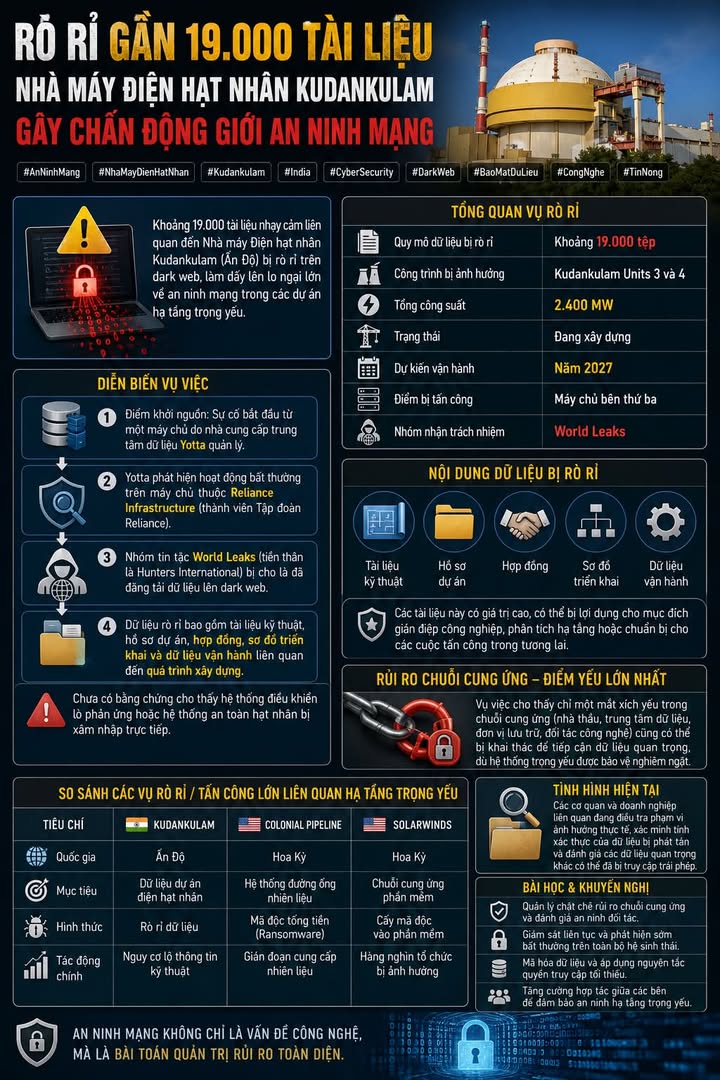
Major Data Breach at India's Kudankulam Nuclear Power Plant Exposes 19,000 Sensitive Documents
The discovery of a massive data breach involving approximately 19,000 sensitive documents related to India's Kudankulam Nuclear Power Plant has sent shockwaves through the cybersecurity community. The breach, which affected critical infrastructure components currently under construction, highlights growing vulnerabilities in the digital ecosystem surrounding essential facilities.
Understanding the Kudankulam Nuclear Power Project
The Kudankulam Nuclear Power Plant, located in the Tamil Nadu state of India, represents one of the country's most significant energy infrastructure projects. The recently compromised data specifically pertains to Units 3 and 4 of the facility, which are currently under construction with a combined capacity of 2,400 MW. These units represent an expansion of the existing operational facility and are expected to become operational by 2027, significantly contributing to India's energy needs.
Nuclear facilities of this magnitude require extensive documentation throughout their lifecycle, from initial planning and construction to eventual operation and decommissioning. The comprehensive nature of these documentation requirements makes them particularly valuable targets for cyber espionage and other malicious activities.
The Breach: Origins and Scope
According to initial investigations, the breach did not originate from the plant's operational control systems but from a third-party server managed by Yotta, a prominent data center provider. The compromised server belonged to Reliance Infrastructure, a subsidiary of India's Reliance Group, which is involved in various aspects of the Kudankulam project.
The breach was discovered when Yotta detected unusual activity on the server. Subsequently, the hacker group World Leaks—reportedly a rebranding of the previously known Hunters International—claimed responsibility and published the stolen data on the dark web, a hidden portion of the internet accessible only through specialized software.
The leaked documents include a wide range of sensitive materials:
- Technical specifications and engineering drawings
- Project documentation and planning materials
- Contractual agreements and vendor information
- System deployment diagrams and network architectures
- Operal procedures and protocols
Assessing the Immediate Impact
While the breach represents a serious security incident, authorities have confirmed that there is no public evidence indicating direct compromise of the plant's reactor control systems or nuclear safety mechanisms. These systems are typically "air-gapped" or have highly restricted network access to prevent unauthorized manipulation.
However, the technical documentation and operational details exposed in the breach could provide valuable intelligence for potential adversaries. Such information could facilitate future attacks, enable more sophisticated reconnaissance, or help identify vulnerabilities that might not be immediately apparent from external observation.
The following table summarizes key aspects of the breach:
| Information Category | Details |
|---|---|
| Scale of Data Breach | Approximately 19,000 files |
| Affected Facility | Kudankulam Units 3 and 4 |
| Total Capacity | 2,400 MW |
| Current Status | Under construction |
| Expected Operational Date | 2027 |
| Breach Origin | Third-party server |
| Claimed Responsibility | World Leaks (formerly Hunters International) |
Context: Comparing Major Cyber Incidents
The Kudankulam breach occurs within a landscape of increasingly sophisticated cyber attacks targeting critical infrastructure. When compared to other major incidents, certain patterns emerge that highlight both unique aspects and common vulnerabilities.
The following table provides a comparison between the Kudankulam breach and two other significant cyber incidents:
| Incident | Kudankulam | Colonial Pipeline | SolarWinds |
|---|---|---|---|
| Country | India | United States | United States |
| Target | Nuclear power project data | Fuel pipeline systems | Software supply chain |
| Attack Method | Data breach via third party | Ransomware | Malicious code injection |
| Primary Impact | Potential intelligence exposure | Fuel supply disruption | Widespread system compromise |
| Scale | 19,000 documents | >Critical infrastructure shutdown18,000+ organizations affected |
Supply Chain Vulnerabilities: A Growing Concern
The Kudankulam breach underscores a critical reality in modern cybersecurity: supply chain vulnerabilities often represent the weakest link in security postures. Even when critical systems themselves are protected, the extensive network of contractors, vendors, and service providers creates multiple potential entry points for attackers.
In the case of nuclear facilities, the ecosystem of partners typically includes engineering firms, construction companies, equipment suppliers, data center providers, and technology vendors. Each of these entities maintains systems that, if compromised, could provide access to sensitive information about the facility.
Dr. Rajesh Kumar, a cybersecurity expert specializing in critical infrastructure protection, commented on the implications: "This breach serves as a stark reminder that protecting critical infrastructure requires a holistic approach that extends beyond the facility's perimeter. Organizations must implement rigorous security assessments for all third-party partners and establish clear protocols for data handling and access controls."
Industry Response and Investigation
In the wake of the breach, authorities and involved organizations have initiated several response measures:
- Forensic analysis to determine the exact scope of the breach
- Verification of the authenticity of leaked documents
- Assessment of whether additional sensitive data was accessed beyond what appeared on the dark web
- Review of security protocols for all third-party vendors
- Enhanced monitoring systems for detecting unusual activity
The Nuclear Power Corporation of India Limited (NPCIL), which operates the Kudankulam plant, has issued a statement acknowledging the incident while emphasizing that operational systems remain secure. The company has indicated that it is cooperating with law enforcement agencies and cybersecurity experts to address the breach.
Broader Implications for Critical Infrastructure Security
The Kudankulam breach has significant implications for how critical infrastructure is protected globally. Several key lessons emerge from this incident:
First, organizations must adopt a "zero trust" approach to security, assuming that any system could potentially be compromised and implementing strict access controls and verification processes regardless of location or ownership.
Second, comprehensive inventory and classification of sensitive data are essential. Organizations must understand what information they possess, where it is stored, and who has access to it in order to implement appropriate protection measures.
Third, continuous monitoring and rapid response capabilities are critical. The ability to detect anomalies quickly and respond effectively can significantly limit the damage from a breach.
Finally, information sharing within the security community is vital. By sharing threat intelligence and attack patterns, organizations can better prepare for and defend against similar attacks.
Looking Forward: Strengthening Defenses
As nuclear and other critical infrastructure projects continue to advance technologically, they will increasingly become targets for sophisticated cyber attacks. The Kudankulam breach should serve as a catalyst for strengthening security measures across the entire lifecycle of such projects.
Future security approaches may include:
- Enhanced segmentation of networks to limit lateral movement
- Implementation of advanced threat detection systems using AI and machine learning
- Regular security assessments and penetration testing
- Development of specialized incident response plans for critical infrastructure
- Strengthened regulatory requirements for third-party security
The Kudankulam incident ultimately demonstrates that in an increasingly connected world, no organization is an island. The security of critical infrastructure depends not only on robust protections for one's own systems but also on the security practices of all partners and vendors in the ecosystem.
As nuclear facilities continue to play a vital role in global energy production, ensuring their cybersecurity will remain an ongoing challenge requiring vigilance, innovation, and collaboration across the entire industry.