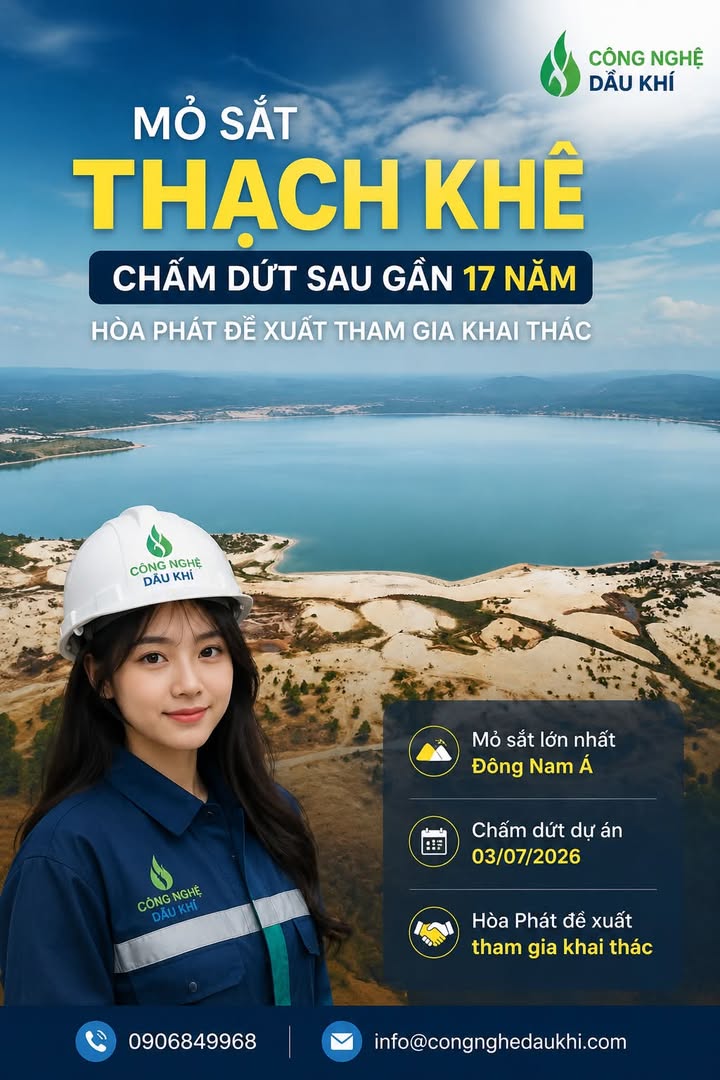
Thach Khe Iron Ore Project Officially Terminated After Nearly 17 Years as Hoa Phat Proposes Mining Involvement
The Thach Khe iron ore mining project, one of the largest and most ambitious mineral extraction ventures in Vietnam's history, has been officially terminated after nearly 17 years of development. The announcement, made on July 3, 2026, marks the end of a controversial journey that has seen the project face numerous technical, environmental, financial, and economic challenges.
In the wake of this decision, Hoa Phat, Vietnam's leading steel producer, has formally proposed to participate in the mining operations, suggesting a consortium with Vietnam National Coal and Mineral Industries Holding Corporation (Vinacomin) and Truong Hanh Automobile and Transportation Corporation (THACO) to explore alternative approaches to extracting the valuable resource.
Background on the Thach Khe Project
The Thach Khe iron ore mine, located in Thach Ha district, Ha Tinh province, was initially envisioned as a strategic national project that would significantly reduce Vietnam's dependence on imported iron ore. With reserves estimated at hundreds of trillions of VND, the mine was considered one of the largest in Southeast Asia and potentially transformative for Vietnam's steel industry.
The project's development timeline spans nearly two decades, with multiple phases of planning, implementation, and suspension. Throughout its history, the mine has represented both tremendous economic potential and significant environmental concerns, creating a complex dilemma for policymakers and investors.
Key Project Specifications
| Parameter | Details |
|---|---|
| Location | Thach Ha District, Ha Tinh Province |
| Announcement Date | July 3, 2026 |
| Mineral Type | Iron Ore |
| Scale | Among the largest iron ore mines in Southeast Asia |
| Proposed Consortium | Hoa Phat, Vinacomin, THACO |
Development Timeline and Challenges
The Thach Khe project has been marked by a series of starts and stops, reflecting the complexity of developing such a large-scale mining operation in environmentally sensitive areas. The project was first approved in the early 2000s with ambitious production targets, but implementation quickly encountered significant obstacles.
Early phases of the project revealed technical difficulties related to the depth of the ore deposits and the complex mineral composition. Unlike more accessible iron ore deposits, Thach Khe's ore required advanced processing techniques that proved challenging to implement cost-effectively.
Environmental and Social Concerns
As the project progressed, environmental concerns became increasingly prominent. Experts warned that mining at the proposed depths could potentially affect groundwater systems, contribute to coastal erosion, and disrupt local ecosystems. These concerns were amplified by the mine's proximity to populated areas and sensitive coastal environments.
Local communities expressed concerns about potential impacts on their livelihoods, particularly fishing and agriculture. The project's location in a coastal region made these concerns particularly acute, as any environmental disruption could have long-term consequences for the local economy and way of life.
Economic Considerations
The economic viability of the Thach Khe project has been a subject of intense debate throughout its development. While the ore reserves are substantial, the costs of extraction, processing, and environmental management have consistently exceeded initial projections.
Several economic analyses suggested that the project's break-even point would require iron ore prices that were significantly higher than market averages, making it economically challenging under normal market conditions. This economic reality, combined with the technical and environmental challenges, contributed to the decision to terminate the project.
Impact on Vietnam's Steel Industry
| Impact Area | Consequences |
|---|---|
| Domestic Iron Ore Supply | Continued limitation on domestic production |
| Steel Production Inputs | Increased dependence on imported raw materials |
| Steel Companies | Need for cost optimization strategies |
| Mining Investments | Greater emphasis on environmental and economic feasibility |
Hoa Phat's Proposal and Industry Response
The proposal by Hoa Phat to lead a consortium in developing the Thach Khe project represents a significant development in Vietnam's mining and steel sectors. As the country's largest steel producer, Hoa Phat has both the technical expertise and financial resources to potentially approach the project with different methodologies than previous developers.
Hoa Phat's proposal includes collaboration with Vinacomin, which has extensive experience in Vietnam's mining sector, and THACO, which has demonstrated capabilities in large-scale industrial development. This consortium would bring together complementary strengths that could address some of the technical and environmental challenges that plagued previous development attempts.
The proposal reflects Hoa Phat's strategic vision of securing domestic raw material supplies to reduce dependence on imports and improve the competitiveness of Vietnam's steel industry in global markets. The company has previously expressed interest in developing domestic mining capabilities as part of its vertical integration strategy.
Future Implications for Resource Development in Vietnam
The termination of the Thach Khe project and the subsequent proposal by Hoa Phat's consortium raise important questions about Vietnam's approach to mineral resource development. The experience with Thach Khe suggests that future large-scale mining projects will need to balance economic objectives with environmental protection and social responsibility more effectively than in the past.
For Vietnam's steel industry, which continues to grow as the country develops, securing reliable raw material supplies remains a critical challenge. While domestic resources like Thach Khe are attractive, they must be developed in ways that are both economically viable and environmentally sustainable.
Lessons Learned and Path Forward
The Thach Khe project offers several valuable lessons for Vietnam's mining sector:
- Comprehensive environmental impact assessments must be conducted early in the planning process
- Technical feasibility studies should be more rigorous and account for all potential challenges
- Stakeholder engagement, particularly with local communities, needs to be more extensive
- Financial models must account for both capital and operational costs, including environmental management
- Alternative mining technologies should be explored that may reduce environmental impact
As Vietnam continues to develop its industrial base, the approach to resource extraction will likely evolve to incorporate these lessons. The Hoa Phat consortium's proposal, if implemented, could demonstrate a new model for large-scale mining that balances economic development with environmental stewardship.
Conclusion
The termination of the Thach Khe iron ore project after nearly 17 years represents a pivotal moment in Vietnam's mining history. While the project's closure means that one of Southeast Asia's largest iron ore deposits will remain undeveloped for the foreseeable future, it also creates an opportunity to reassess how such valuable national resources should be utilized.
Hoa Phat's proposal to lead a consortium in developing the mine suggests that there may still be pathways to extracting this resource responsibly. However, any future development will need to address the technical, environmental, and economic challenges that ultimately led to the project's termination.
For Vietnam's steel industry and broader economy, the Thach Khe experience underscores the importance of developing domestic resources while maintaining rigorous standards for environmental protection and economic viability. As the country continues its industrial development, finding this balance will be essential to sustainable growth.