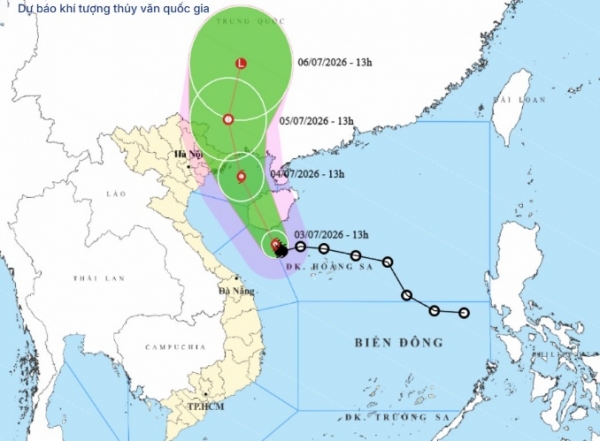
Typhoon No. 1 Intensifies Toward Quang Ninh-Hung Yen: Forecasting Technology and Disaster Response Strategies
In an era of increasingly complex climate change, the application of technology in weather forecasting and disaster response has become a critical survival factor. Typhoon No. 1 (Maysak) has recently intensified and is moving toward the border area between Quang Ninh and China, serving as a clear demonstration of the importance of technology in disaster prevention and control.
Detailed Information About Typhoon No. 1 (Maysak)
According to the National Center for Hydro-Meteorological Forecasting, Typhoon No. 1 (Maysak) has strengthened into a level 8-9 typhoon with gusts reaching level 11 and is showing a tendency to shift northwestward. The typhoon is forecast to enter the border area between Quang Ninh and China during the night of July 4th, early morning of July 5th.
| Parameter | Value |
|---|---|
| Typhoon Name | Maysak |
| Typhoon Level | 8-9 |
| Strongest Winds | 62-83 km/h, with gusts to level 11 |
| Direction of Movement | Northwest |
| Affected Area | East Sea, border area between Quang Ninh and China |
| Expected Landfall Time | Night of July 4th, early morning of July 5th |
Modern Typhoon Forecasting Technology: From Satellites to AI
Today's modern weather forecasting systems represent a combination of several advanced technologies. Weather satellites such as GOES, Himawari, and Meteosat provide detailed imagery of typhoon structure and movement with high resolution.
Vietnam is utilizing the WRF (Weather Research and Forecasting) high-resolution modeling system, which allows for more detailed forecasting of typhoon tracks, intensity, and landfall timing. This system integrates data from automated meteorological and oceanographic observation stations across the country.
Big Data analytics and Artificial Intelligence (AI) technologies are revolutionizing the weather forecasting industry. Machine learning algorithms can analyze terabytes of meteorological data to identify complex patterns, enabling more accurate forecasts with longer lead times.
Key Technologies in Modern Weather Forecasting
- Satellite imagery and remote sensing
- Numerical weather prediction models
- Machine learning and AI pattern recognition
- IoT sensor networks
- Supercomputing for complex atmospheric modeling
Technology Applications in Typhoon Response
The application of technology in typhoon prevention and response in Vietnam has been continuously enhanced. Early warning systems are integrated across multiple platforms, including television, radio, mobile applications, and public LED displays.
The V Weather application of the General Department of Meteorology and Hydrology provides updated weather information, typhoon warnings, and extreme weather alerts directly to users. Such applications use GPS technology to provide location-specific warning information to users in their current areas.
Drone technology is being widely used in post-typhoon monitoring and damage assessment. Unmanned aerial vehicles can access hard-to-reach areas, providing high-quality images and videos to assess the extent of damage.
In coastal areas, typhoon-resistant construction technology has been continuously improved. Structures use new materials, more resilient designs, and integrated smart monitoring systems to detect early signs of potential collapse.
Technology-Enabled Response Measures
- Mobile alert systems with geolocation capabilities
- Drone-based damage assessment
- Smart infrastructure monitoring
- Social media coordination platforms
- Resource management optimization software
Vietnam's Experience with Typhoon Response
With a coastline of over 3,260 km, Vietnam frequently faces typhoons and tropical depressions. In recent years, technology has helped significantly reduce casualties and property damage.
Typhoon No. 9 in 2023 serves as a clear example. Thanks to accurate forecasting systems and early warning technologies, authorities evacuated more than 500,000 people before the typhoon made landfall, minimizing human casualties.
However, challenges remain. Many rural, remote areas still lack access to modern warning systems. Investing in technological infrastructure in these regions is a top priority for the future.
Lessons Learned from Recent Typhoons
- Early evacuation saves lives
- Communication infrastructure resilience is critical
- Real-time data improves response coordination
- Community-based warning systems are effective
- Post-disaster assessment technology speeds recovery
Future Prospects for Forecasting and Disaster Response Technology
The future of weather forecasting and disaster response technology in Vietnam points toward the integration of multiple advanced technologies. Next-generation supercomputers will enable higher-resolution atmospheric modeling, leading to more accurate forecasts.
5G and IoT (Internet of Things) technologies will create dense sensor networks collecting real-time weather data. Virtual Reality (VR) and Augmented Reality (AR) technologies will be used in rescue training and disaster preparedness drills.
Vietnam is also strengthening international cooperation in disaster response technology. The "Development of High-Technology-Based Early Warning Systems for Natural Disasters" project is a prime example, involving experts from Japan, South Korea, and other developed countries.
Emerging Technologies in Disaster Management
- Predictive analytics for disaster impact assessment
- Blockchain for resource allocation and distribution
- Autonomous vehicles for emergency response
- Quantum computing for complex weather modeling
- Digital twins for infrastructure resilience testing
Conclusion
Typhoon No. 1 (Maysak) once again reminds us of the destructive power of nature and the importance of technology in forecasting and response. Continued investment, development, and application of technology in disaster prevention and control is not only an urgent requirement but also a strategic direction to protect the safety of lives and property.
Individuals also need to raise awareness and proactively equip themselves with knowledge and technological tools to protect themselves and their families before disasters strike. In the context of increasingly complex climate change, technology stands as humanity's strongest shield against the power of nature.
The integration of advanced forecasting technologies, early warning systems, and disaster response strategies represents our best defense against the growing threat of extreme weather events in a changing climate.