#LNG #LNGTanker #HangHai #COLREGS #WhenTuNhienHoaLong #CongNgheDauKhi #AnToanHangHai #TauBien #NangLuong #MarineSafety
If a captain misidentifies the signal of an LNG ship in the dark, could just a few seconds of delay lead to a collision causing tens of thousands of billions of dong in damage and threatening the safety of hundreds of people?
In the international maritime industry, small glowing bulbs on ship hulls are more than just lighting devices. They are the universal language of the sea. Especially for LNG carriers, accurate identification of lighting systems and daytime markings plays an extremely important role in maritime safety.
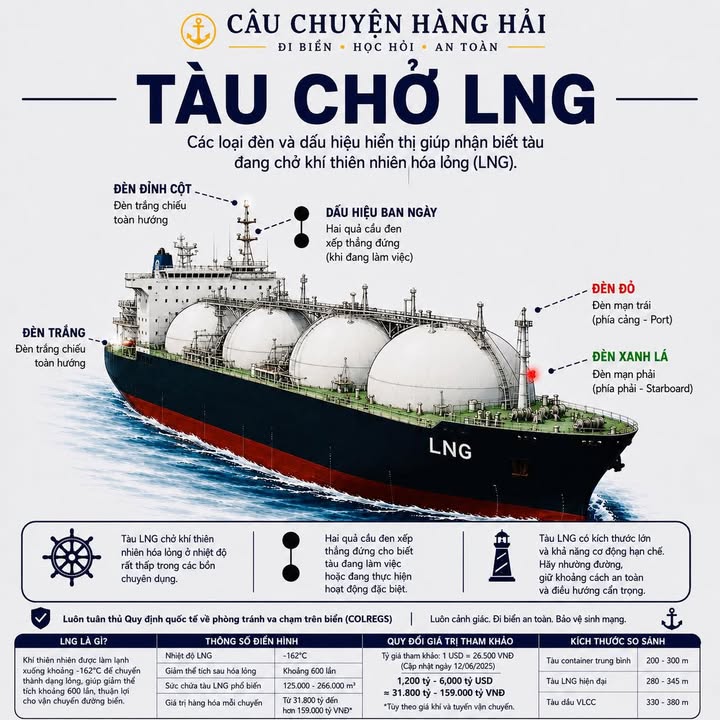
The image shared by Marine Tales on June 12, 2026 depicts the basic identification light system on an LNG ship traveling at sea according to COLREGS international regulations.
WHAT IS LNG AND WHY LNG VESSELS ARE OF SPECIAL INTEREST
LNG is natural gas that is cooled to about minus 162 degrees Celsius to turn into liquid form.
Thanks to the liquefaction process, the gas volume is reduced by about 600 times, helping to transport huge amounts of energy on international maritime routes.
An L trainModern NG can transport gas worth from about 1,200 billion to more than 6,000 billion VND depending on load, gas price and transportation route.
Parameter Typical value
LNG temperature -162°C
Reduced volume after liquefaction About 600 times
Common LNG ship capacity is 125,000 - 266,000 m³
Value of goods per trip From 1,200 billion to more than 6,000 billion VND
MEANING OF TYPES OF LIGHTS ON LNG SHIPS
At night or in conditions of limited visibility, ships use a standard marine lighting system to notify operating status.
Signal light Color Meaning
Port light Red Identify port side
Starboard light Green Identifies Starboard side
White mast top light Identifies ship's direction and status
White all-directional lights Warning and identification support
When it sees the red light but not the green light, the observation ship is looking at the port side of the LNG ship.
When it sees the green light but not the red light, the observation ship is looking to the starboard side.
When both red and green lights are seen simultaneously, the LNG ship is approaching head-on.
SIGNS OF THE DAY THAT A SAILOR MUST KNOW BY HEART
In addition to the night light system, LNG ships also use daytime identification signs.
In the illustration there are two black spheres hanging vertically.
According to international regulations, this is the marksigns indicating that a ship is on special duty or in a prescribed state must be clearly identifiable to other ships.
Sign Meaning
Two black spheres arranged vertically Identify operating status according to maritime regulations
There is no usual Cruise Ship sign
WHY ARE LNG VESSELS OFTEN GIVEN WAY
LNG ships are very large in size.
Many ships are from 280 to more than 345 meters long, equivalent to the length of three football fields placed end to end.
Full load weight can exceed 150,000 tons.
This makes the turning radius very large and the reaction time significantly longer than that of a conventional cargo ship.
Ship type Length
Container ships average 200 - 300 m
Modern LNG vessel 280 - 345 m
VLCC tanker 330 - 380 m
Due to this characteristic, other vessels are often recommended to keep a greater safe distance when operating near LNG vessels.
ACCIDENTS WHEN SIGNALS ARE MISIDENTIFIED
In world maritime history, many collisions occurred due to misidentification of the ship's direction of travel or operating status.
The cause usually comes from:
• Not understanding the meaning of navigational lights
• Inadequate observation in bad weather conditions
• Non-compliance with COLREGS rules
• Lack of experience in managing committeesnight
An incident involving an LNG vessel not only causes damage to the vehicle but can also disrupt the international energy supply chain.
CONCLUSION
In the middle of the vast ocean, seemingly simple red, blue and white light bulbs are the vital language system of the global maritime industry.
For LNG ships, which transport strategic energy resources worth trillions of VND per trip, understanding and complying with identification signals is not only a legal requirement but also a deciding factor in the safety of the crew, cargo and the marine environment.
One small light bulb can save the whole ship.
A correct signal can prevent a disaster worth tens of trillions of dong.
#LNG #LNGCarrier #NaturalGas #Maritime #COLREGS #MarineEngineering #Offshore #ShippingIndustry #CongNgheDauKhi #Energy #AnToanHangHai #TauLNG #KhiTuNhienHoaLong #HangHaiQuocTe #DauKhiVietNam