#BESS #LuuTruNangLuong #BatteryLithium #NangLuongTaiTao #DienGio #DienMatTroi #QuyHoachDienVIII #CongNgheDauKhi #TimKiemTop
If tens of thousands of MW of battery storage are deployed nationwide but lack safety standards, could just one big fire cause a domino effect affecting the entire national power system?
The explosion of solar power and wind power is making the BESS energy storage battery system one of the most important infrastructures in the electricity industry. However, along with opportunities come significant risks as the world has witnessed many BESS fires and explosions in the US, Korea, China and Australia.
In that context, Vietnam's issuance of TCVN 14499-4-3:2025 is considered an important turning point, marking a shift from technology promotion thinking to technology risk management for electricity storage infrastructure.
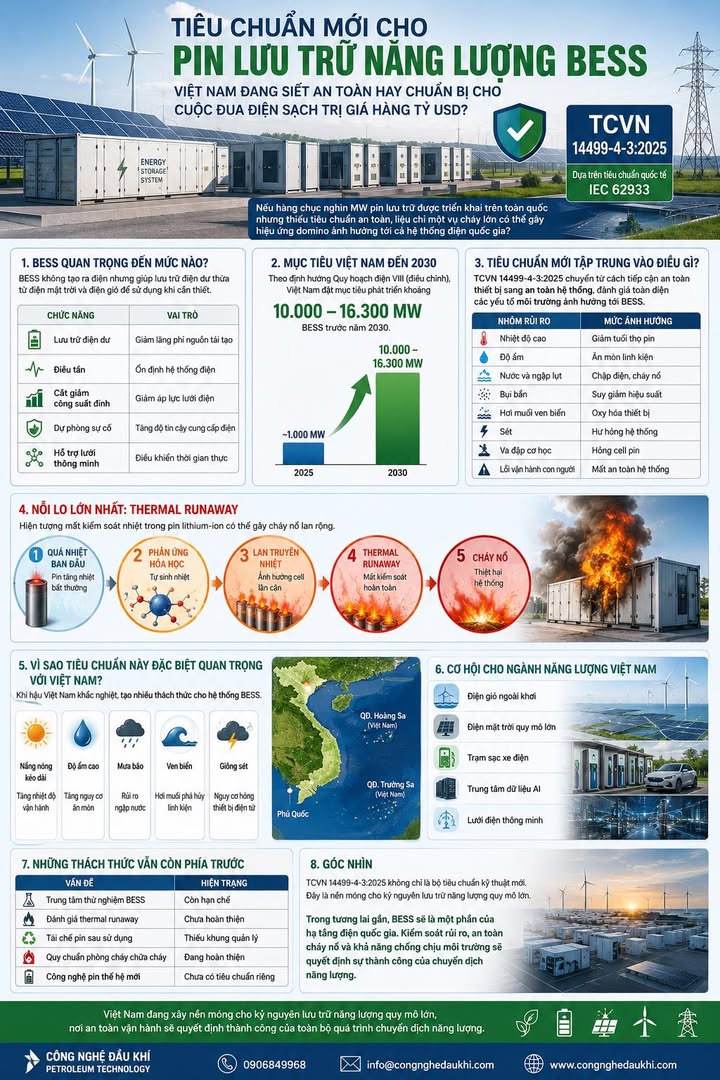
How important is BESS?
BESS does not generate electricity but helps store excess electricity from solar and wind power for use when needed.
Function Role
Store excess electricity Reduce waste of renewable resources
Frequency regulation Stabilize the systemyes
Cut peak power Reduce grid pressure
Fault backup Increase power supply reliability
Supports smart grid Real-time control
According to the adjusted Power Plan VIII orientation, Vietnam aims to develop about 10,000 MW to 16,300 MW BESS before 2030. This shows that storage batteries will become an indispensable part of the national electricity infrastructure.
What does the new standard focus on?
The biggest difference of TCVN 14499-4-3:2025 is the shift from the equipment safety approach to system safety.
The standard requires a comprehensive assessment of environmental factors that may affect the BESS.
Risk group Influence level
High temperatures Reduce battery life
Humidity Corrodes components
Water and flooding Electrical short circuit, fire and explosion
Dust and dirt Reduced performance
Coastal salt vapor Oxidizes equipment
Lightning System damage
Mechanical impact Damage to battery cells
Human operator error Loss of system security
These are especially important factors for Vietnam when many wind and solar power projects are located in the South Central coastal region, the Southwest and harsh climate zones.
The biggest worry is called Thermal Runaway
One of the most concerning contents in the new standard is the phenomenon of loss of controlt heat.
When a lithium-ion battery cell overheats, the chemical reaction inside will continuously generate heat and spread to neighboring cells.
The results may result
Battery fire
Explosion of accumulated gas
Damage to the entire system
Large power outage if large grid connection
Development Phase
Initial overheating The battery heats up abnormally
Chemical reaction Self-heating
Heat spread Affects neighboring cells
Thermal Runaway Complete loss of control
Fire, explosion, system damage
This is the cause of many famous BESS incidents around the world in recent years.
Why is this standard especially important for Vietnam?
Vietnam's climate is one of the harshest environments for storage batteries.
Environmental conditions Impact on BESS
Prolonged hot weather Increase operating temperature
High humidity Increases the risk of corrosion
Rainstorm Risk of flooding
Coastal Salt vapor destroys components
Thunderstorm Risk of damage to electronic equipment
Meanwhile, most current battery storage technology is imported from countries with temperate climates, making the localization of standards a mandatory requirement.
Opportunities for Vietnam's energy industry
Applying standards based on IEC 62933 helps Vietnam gradually integrate with technical standardst international.
Benefits include:
✅ Unify technical standards throughout the industry
✅ Reduce the risk of fire, explosion and operational problems
✅ Attract investment in wind power and solar power
✅ Support the development of electric vehicle charging infrastructure
✅ Create a foundation for AI data centers that consume large amounts of electricity
In particular, when AI data centers and smart power systems develop strongly in the period 2026–2035, BESS will become a strategic link to help balance load and ensure energy security.
Challenges still lie ahead
Even though there are technical standards, Vietnam is still facing many gaps.
Current Status Issue
BESS testing center Limited
Thermal runaway review Incomplete
Recycle batteries after use. Lack of management framework
Fire prevention and fighting standards are being completed
New generation battery technology There is no separate standard
Experts say standards are just the beginning. If you want the BESS market to develop sustainably, it is necessary to be synchronous from technical regulations, inspection, testing to actual operation monitoring.
Viewing angle
TCVN 14499-4-3:2025 is not simply a new set of technical standards. This is a sign that Vietnam is preparing the foundation for the era of large-scale energy storage.
AshIn the near future, storage batteries will no longer be an auxiliary device for solar or wind power but will become part of the national electricity infrastructure. Then, risk control, fire safety and environmental resilience will determine the success of the entire energy transition process.
Can Vietnam become one of the fastest growing BESS markets in Southeast Asia before 2030 or will technology and safety barriers still be a difficult problem?
#NangLuong #BESS #BatteryLithium #LuuTruNangLuong #DienMatTroi #DienGio #AnNinhNangLuong #QuyHoachDienVIII #CongNgheDauKhi #TimKiemTop