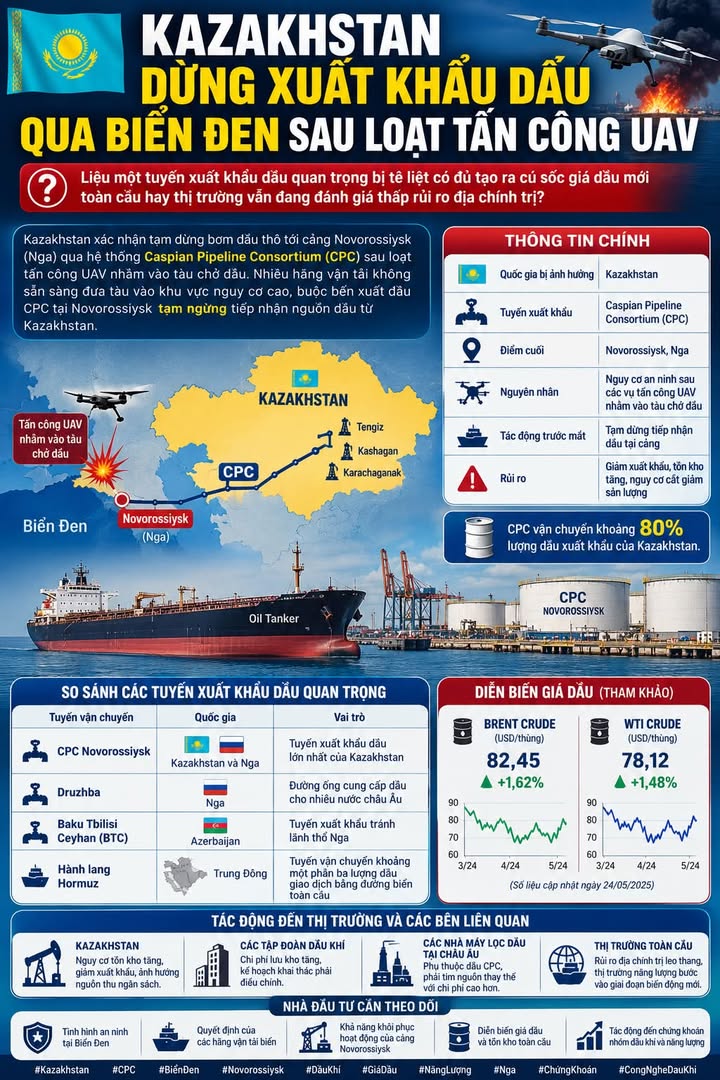
Is the paralysis of an important oil export route enough to create a new global oil price shock, or is the market still underestimating geopolitical risks?
Kazakhstan has just confirmed the temporary suspension of pumping crude oil to the Russian port of Novorossiysk on the Black Sea through the Caspian Pipeline Consortium CPC system after a series of drone attacks targeting oil tankers caused shipping companies to increase safety concerns. According to Bloomberg, the CPC oil export terminal in Novorossiysk will temporarily stop receiving oil from Kazakhstan because many shipping businesses are not willing to send ships into high-risk areas.
The CPC is Kazakhstan's most important oil export route, transporting much of the output from giant fields such as Tengiz, Kashagan and Karachaganak to international markets. When this shipping route is interrupted, Kazakhstan not only faces the risk of a sharp increase in inventory but may also be forced to cut mining output if no alternative is found.
Main information panel
Content Information
Quaffected country Kazakhstan
Caspian Pipeline Consortium CPC export route
End point Novorossiysk, Russia
Cause Security risk after UAV attacks on oil tankers
Immediate impacts Temporarily stop receiving oil at the port
Risks Reduced exports, increased inventories, risk of production cuts
CPC is especially important for Kazakhstan, transporting about 80 percent of the country's oil exports. Prolonged disruption will directly affect budget revenues, operations of international mining corporations and crude oil supply chains for Europe.
Comparison table of oil export routes
Shipping Route Country Role
CPC Novorossiysk Kazakhstan and Russia Kazakhstan's largest oil export route
Druzhba Russia Pipeline supplies oil to many European countries
Baku Tbilisi Ceyhan Azerbaijan Export route avoids Russian territory
Hormuz Middle East Corridor The route carries about a third of global seaborne oil trade
For the oil market, the new incident further increases supply pressure in the context of geopolitical tensions still present in many regions. If CPC's operations are stagnant for a long time, the amount of Kazakh oil reaching the international market will increaseThe price will decrease significantly, creating conditions for Brent and WTI prices to maintain in high areas.
In addition to the impact on oil prices, large mining enterprises operating in Kazakhstan will also be under pressure when export rates decrease, storage costs increase and exploitation plans may have to be adjusted. Oil refineries in Europe that depend on CPC oil will also have to look for alternative sources at higher costs.
In the short term, investors will closely monitor the security situation in the Black Sea, the decisions of shipping companies and the ability to restore operations of Novorossiysk port. If risks continue to escalate, the global energy market could enter a new period of volatility with oil prices remaining at higher-than-expected levels.
#Kazakhstan #CPC #Black Sea #Novorossiysk #OilGas #Oil Price #Brent #WTI #Russia #Energy #Stocks #CongHeatDauKhi