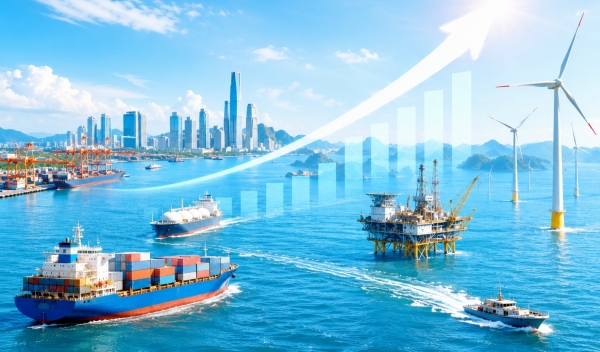
Unlocking Vietnam's Maritime Economy to Achieve Double-Digit Growth
In an era of global economic uncertainty and Vietnam's ambitious goal of achieving double-digit economic growth in the coming years, developing new high-value growth spaces has become an urgent imperative. According to Associate Professor Dr. Ngô Trí Long, a leading economic expert, the maritime economy represents a strategic frontier that could break through for the national economy, helping Vietnam realize its impressive growth ambitions.
The Untapped Potential of Vietnam's Maritime Economy
Vietnam boasts a coastline stretching over 3,260 kilometers, an exclusive economic zone covering more than 1 million square kilometers, and a continental shelf of over 400,000 square kilometers, with tremendous potential for natural resources and strategic geographical positioning. However, this potential has not been effectively exploited, with the maritime economy's contribution to GDP reaching only about 4-5%, significantly lower than regional peers such as Malaysia, Indonesia, and the Philippines.
The maritime economy encompasses several key sectors including:
- Marine fisheries and aquaculture
- Oil and gas and seabed resource extraction
- Maritime transport and logistics
- Coastal and island tourism
- Renewable energy (offshore wind, solar power)
- High-tech industries related to the marine sector
Challenges in Developing the Maritime Economy
Despite its significant potential, Vietnam faces numerous challenges in developing its maritime economy:
- Deteriorating marine environmental pollution
- Inadequate and inefficient port infrastructure systems
- Limited science and technology capabilities
- Shortage of high-quality human resources for marine industries
- Unsustainable resource extraction practices
- Conflicting interests in maritime space utilization
Table 1: Comparison of Maritime Economic Potential Between Vietnam and Regional Countries
| Indicator | Vietnam | Malaysia | Indonesia | Philippines |
|---|---|---|---|---|
| Coastline length (km) | 3,260 | 4,675 | 54,716 | 36,289 |
| Exclusive economic zone (million km²) | 1 | 3.3 | 6.1 | 2.7 |
| Maritime economy's contribution to GDP (%) | 4-5 | 15 | 12 | 10 |
| Export value of aquatic products (billion USD) | 9.2 | 3.8 | 6.5 | 2.1 |
Strategy for Unlocking the Maritime Economy
To fully leverage Vietnam's maritime potential, Associate Professor Dr. Ngô Trí Long proposes a comprehensive strategy with the following solutions:
1. Developing Integrated Maritime Infrastructure
Investing in modern port systems, connecting maritime and land transportation networks, and developing coastal economic zones to create seamless value chains from production to consumption.
2. Adopting Advanced Technologies
Enhancing the application of digital technology, automation, and artificial intelligence in marine resource exploitation and conservation, while developing high-tech industries related to the maritime sector.
3. Promoting Sustainable Development
Establishing a sustainable maritime economic development strategy that balances resource exploitation with marine environmental protection, ensuring benefits for future generations.
4. Enhancing Science and Technology Capabilities
Increasing investment in marine scientific research, developing high-quality human resources, and fostering international cooperation in marine science and technology.
5. Improving Institutional Frameworks and Policies
Creating a complete, transparent legal system to manage and utilize maritime space effectively, while attracting private investment into maritime economic projects.
Success Stories from Other Nations
Many countries worldwide have successfully exploited their maritime potential to boost economic growth. Singapore, with its strategic location, has become the world's leading logistics hub. Norway has leveraged offshore oil and gas resources to build the world's largest sovereign wealth fund. Nordic countries like Denmark and the Netherlands have successfully developed offshore wind energy industries.
Table 2: Forecast of Maritime Economy's Contribution to Vietnam's GDP by 2030
| Year | Absolute Value (billion USD) | Share of GDP (%) | YoY Growth (%) |
|---|---|---|---|
| 2023 | 35-40 | 4.5-5 | 8-10 |
| 2025 | 50-55 | 6-6.5 | 12-15 |
| 2030 | 80-90 | 8-9 | 15-18 |
Conclusion
Unlocking the maritime economy is not merely an urgent requirement to achieve Vietnam's double-digit growth target but also a strategic pathway for sustainable economic development. With tremendous potential, government determination, and active participation from businesses and experts, the maritime economy promises to become a new growth driver, establishing Vietnam as a strong maritime nation enriched by its sea resources.
Sustainable and effective development of the maritime economy will not only bring economic benefits but also contribute to protecting maritime sovereignty and enhancing Vietnam's international standing.