## The Rush for Exploration Permits Before Potential Political Shift
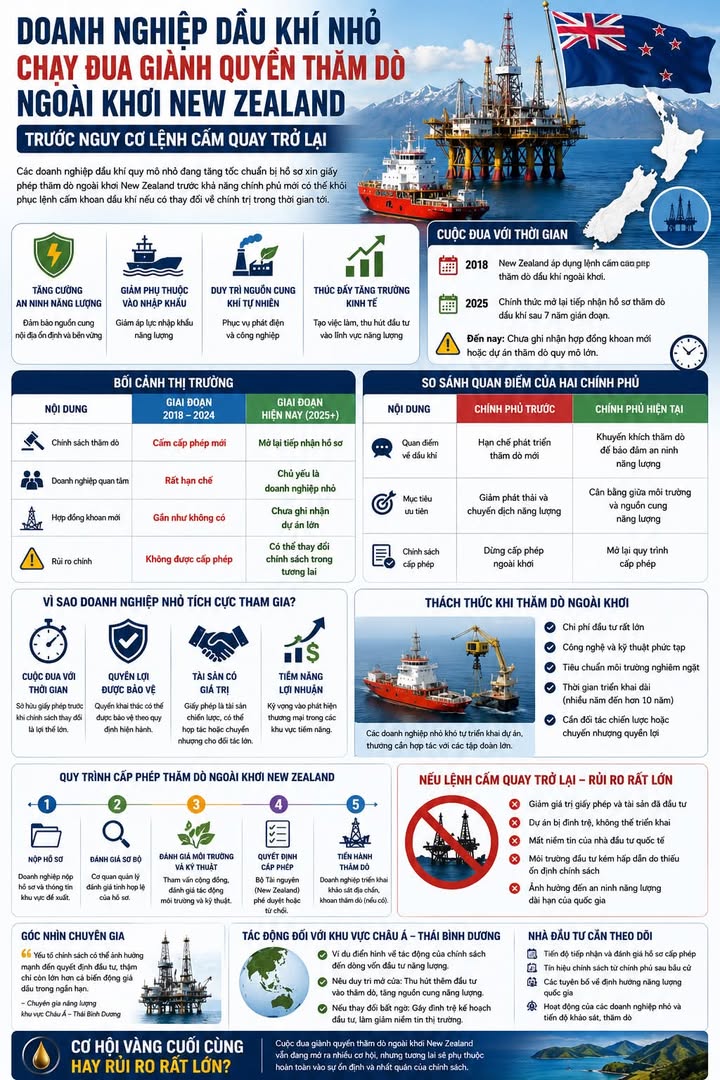
In a high-stakes race against time, small oil and gas companies are accelerating their applications for offshore exploration permits in New Zealand, capitalizing on a narrow window of opportunity before potential political changes could reimpose a drilling ban. This strategic maneuver represents what industry analysts describe as a "golden opportunity" for nimble players in the sector, even as larger international corporations remain on the sidelines due to political uncertainty.
The current regulatory framework allows for permit applications following the government's decision to lift a moratorium imposed in 2018. However, with elections potentially bringing policy shifts, the window for securing exploration rights may be closing soon, creating an unprecedented situation where smaller companies are taking the lead in what could be New Zealand's offshore exploration renaissance.
## Background: New Zealand's Energy Policy Evolution
New Zealand's relationship with offshore oil and gas exploration has undergone significant transformations in recent years. The nation, traditionally cautious about resource extraction, implemented a comprehensive ban on new offshore exploration permits in 2018 as part of its broader environmental commitments. This moratorium effectively halted new offshore drilling activities for seven years, creating a vacuum in the domestic energy exploration landscape.
In 2025, the government officially reopened the application process for offshore exploration permits. This policy shift was driven by multiple factors:
- Growing concerns about energy security and import dependence
- Recognition of natural gas's continued role in power generation and industrial processes
- Economic considerations related to potential job creation and revenue generation
The reopening represents a delicate balance between environmental protection and energy security objectives, reflecting the complex energy policy calculus facing many nations transitioning toward renewable energy sources.
## Why Small Companies Are Leading the Charge
Unlike their larger international counterparts, smaller oil and gas companies have emerged as the most active participants in New Zealand's reopened offshore exploration market. This trend can be attributed to several strategic factors:
### Agility in Regulatory Navigation
Smaller companies possess greater operational flexibility, allowing them to prepare and submit exploration applications more quickly than larger corporations burdened by complex internal approval processes. This agility gives them a crucial first-mover advantage in the current permitting environment.
### Strategic Asset Acquisition
By securing exploration permits now, smaller companies aim to build valuable asset portfolios that could later be monetized through partnerships with larger international firms or developed independently if favorable market conditions emerge. These permits represent strategic assets that could appreciate significantly if exploration proves successful.
### Risk Appetite and Specialization
Many smaller exploration companies specialize in frontier or high-potential, high-risk exploration projects that larger firms often avoid. Their business models are built around identifying and securing opportunities in emerging markets before they attract mainstream attention.
### Diversification Strategies
For some small players, New Zealand represents diversification away from traditional exploration regions increasingly subject to climate-related restrictions or geopolitical tensions.
## Market Context: A Tale of Two Periods
The following table illustrates the dramatic shift in New Zealand's offshore exploration landscape:
| New Zealand Offshore Exploration Market Context | ||
|---|---|---|
| Parameter | 2018-2024 (Moratorium Period) | 2025-Present (Post-Moratorium) |
| Exploration Policy | Moratorium on new permits | Reopened application process |
| Industry Interest Level | Very limited | Moderate, primarily small companies |
| New Drilling Contracts | Nearly zero | No major projects yet announced |
| Primary Risk | Unable to secure permits | Policy reversal potential |
The contrasting approaches of New Zealand's previous and current administrations highlight the political dimension of energy policy:
| Comparing Government Approaches to Oil and Gas | ||
|---|---|---|
| Policy Aspect | Previous Administration | Current Administration |
| Exploration Philosophy | Limited new exploration, focus on existing fields | Encouraged exploration for energy security |
| Primary Objective | Emission reduction and energy transition | Balancing environmental and energy supply needs |
| Permitting Approach | Paused new offshore permits | Reopened permitting process with environmental safeguards |
While small companies are actively pursuing exploration opportunities, significant challenges remain:
### Capital Intensity
Offshore exploration is extraordinarily capital-intensive, with exploration wells costing tens of millions of dollars each. Most small companies will need to secure partnerships or joint ventures with larger firms to fund actual exploration activities.
### Technological Requirements
Modern offshore exploration requires advanced seismic technologies, specialized drilling equipment, and sophisticated data analysis capabilities—resources that may exceed the capacity of smaller firms.
### Environmental Compliance
New Zealand maintains stringent environmental standards for offshore activities, requiring comprehensive environmental impact assessments and mitigation plans. Compliance adds both time and cost burdens to exploration projects.
### Market Timing and Policy Risk
The fundamental challenge remains the uncertain policy timeline. If a new government reimposes exploration restrictions, companies with permits but no production may find their investments stranded, creating significant financial risks.
## Industry Implications and Future Outlook
The current situation in New Zealand offers several important lessons for the global energy industry:
### Policy Stability as Investment Prerequisite
The experience in New Zealand demonstrates that policy stability may be an even greater factor in investment decisions than short-term commodity price fluctuations. Investors consistently cite regulatory uncertainty as a primary risk factor in long-term energy projects.
### The Role of Smaller Players in Frontier Markets
Small companies often serve as pioneers in emerging exploration regions, assuming higher risks but potentially reaping greater rewards if successful. Their activity can "de-risk" areas for larger players to follow.
### Balancing Energy Security and Environmental Goals
New Zealand's approach reflects a global trend toward finding pragmatic balances between energy security needs and environmental imperatives—a challenge that will define energy policy in the coming decades.
### Asia-Pacific Energy Dynamics
For the broader Asia-Pacific energy market, New Zealand's experience serves as a case study in how political factors can influence investment decisions, sometimes outweighing even significant resource potential.
## Expert Perspectives
Industry analysts suggest that if New Zealand maintains its open exploration policy for a sufficient duration, the country could attract substantial investment. However, the constant threat of policy reversal creates a "stop-start" dynamic that discourages the long-term commitments necessary for meaningful development.
"Small companies are making strategic moves to secure positions in what they hope will become a more stable exploration environment," noted one energy sector analyst. "Their success will depend not just on finding resources, but on navigating an increasingly complex policy landscape."
For investors, the coming months will be critical in determining whether the current flurry of permit applications translates into actual exploration activity or remains largely preparatory in nature. The outcome will likely influence how other jurisdictions approach similar balancing acts between resource development and environmental protection.
As the world transitions toward a more complex energy future, New Zealand's experience offers valuable insights into the interplay between policy, investment, and the evolving role of fossil fuels in the global energy mix.