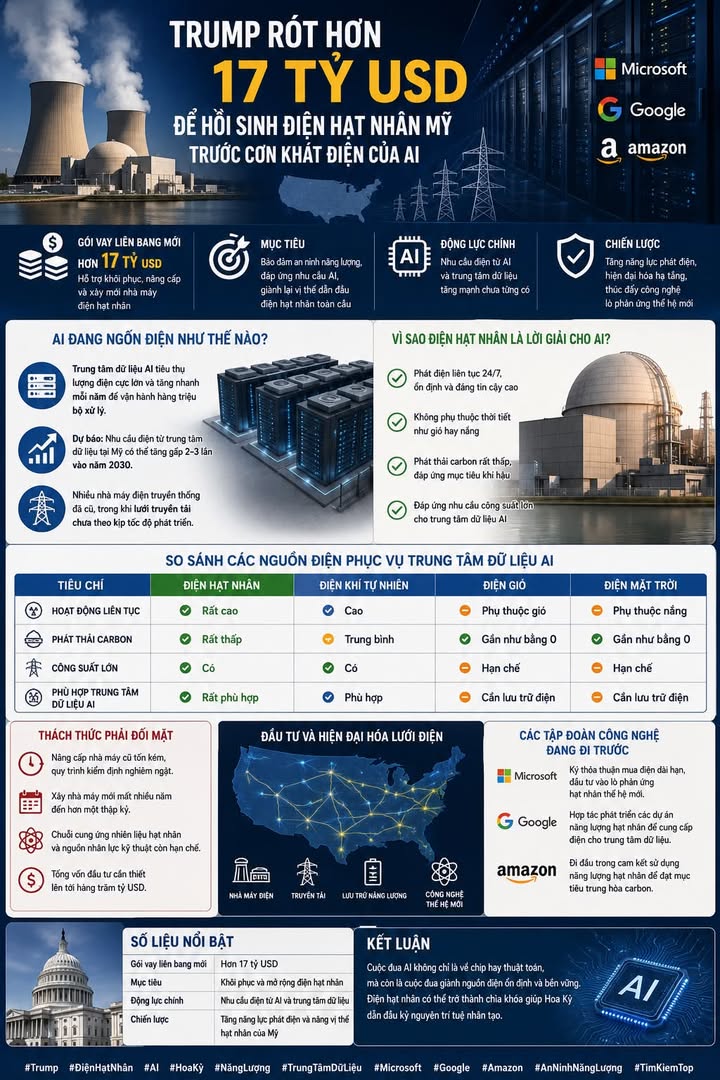
Trump's $17 Billion Nuclear Revival Plan: America's Response to the AI Electricity Crisis
The explosive growth of artificial intelligence is creating unprecedented pressure on the United States' electrical grid. As data centers for AI continue to expand exponentially, the demand for electricity is skyrocketing while traditional power plants age and transmission infrastructure struggles to keep pace. In response to this looming energy crisis, the Trump administration is spearheading a major nuclear energy revival program, committing over $17 billion in federal loans to restore and upgrade existing nuclear plants while encouraging investment in new projects.
The AI Electricity Conundrum
The rapid advancement of artificial intelligence has transformed from a niche technological field into a mainstream driving force across industries. Large language models, generative AI, and machine learning applications require immense computational power, which in turn demands enormous amounts of electricity. Tech giants like Microsoft, Google, and Amazon are racing to build data centers equipped with hundreds of thousands of AI processors, each facility consuming as much power as a small city.
This surge in demand comes at a critical juncture for America's energy infrastructure. Many coal-fired power plants have been retired, renewable energy sources remain intermittent, and the grid's transmission capabilities are insufficient to handle the load. The North American Electric Reliability Corporation (NERC) has already warned that parts of the country could face electricity shortages within the next few years as AI adoption accelerates.
Trump's Nuclear Renaissance Initiative
Against this backdrop, the Trump administration has announced a comprehensive strategy to revitalize nuclear energy in the United States. The centerpiece of this initiative is a package of over $17 billion in federal loans designed to support the restoration and modernization of existing nuclear power plants, while simultaneously incentivizing private investment in next-generation nuclear projects.
"This is about more than just keeping the lights on," stated administration officials. "It's about ensuring American energy independence, creating high-tech jobs, and maintaining our competitive edge in the global AI race. Nuclear power provides the reliable, baseload electricity that our digital economy demands."
The initiative represents a significant policy shift, acknowledging nuclear energy's potential to address both immediate energy needs and long-term sustainability goals. The administration aims not only to secure domestic energy supplies but also to reestablish American leadership in the global nuclear technology market, which has been increasingly dominated by countries like China and Russia in recent years.
Why Nuclear Power is Ideal for AI Infrastructure
Nuclear energy presents several advantages that make it particularly suitable for powering AI data centers:
- Continuous Power Generation: Nuclear plants operate 24/7, unaffected by weather conditions or time of day, unlike solar or wind power.
- High Power Density: A single nuclear facility can generate enormous amounts of electricity from a relatively small physical footprint, making it ideal for areas with limited space.
- Low Carbon Emissions: Nuclear power produces virtually no greenhouse gases during operation, addressing environmental concerns associated with fossil fuels.
- Long-Term Stability: Nuclear facilities can operate for decades with consistent output, providing the reliability that tech companies require for their long-term planning.
"For AI workloads, you need a power source that's always on and always stable," explains Dr. Sarah Chen, a former Department of Energy energy advisor. "Nuclear provides that foundation. You can't have AI systems going offline because the wind isn't blowing or the sun isn't shining. The stakes are simply too high for mission-critical applications."
Comparing Power Sources for AI Data Centers
When evaluating different energy sources for AI infrastructure, several factors must be considered: reliability, environmental impact, scalability, and cost. The following table provides a comparison of various power options:
| Criteria | Nuclear | Natural Gas | Wind | Solar |
|---|---|---|---|---|
| Continuous Operation | Very High | High | Dependent on wind | Dependent on sunlight |
| Carbon Emissions | Very Low | Moderate | Near Zero | Near Zero |
| High Power Capacity | Yes | Yes | Limited | Limited |
| Suitability for AI Data Centers | Excellent | Good | Requires energy storage | Requires energy storage |
Challenges to the Nuclear Revival
Despite the clear advantages, the nuclear revival initiative faces significant hurdles:
- Aging Infrastructure: Most U.S. nuclear plants have been operating for decades. Upgrading them requires massive investment and rigorous safety certifications.
- Construction Timeline: Building new nuclear facilities can take 10-15 years from planning to operation, creating a gap that immediate solutions cannot fill.
- Supply Chain Issues: The domestic nuclear supply chain has atrophied in recent years, with fewer specialized manufacturers and skilled workers available.
- Public Perception: Concerns about safety, waste disposal, and cost continue to influence public opinion and regulatory decisions.
- Regulatory Hurdles: The complex regulatory environment for nuclear projects can delay or derail even well-funded initiatives.
"The challenges are substantial but not insurmountable," argues Michael Reynolds, CEO of a leading nuclear technology firm. "What we need is a coordinated effort between government and industry to streamline processes, invest in workforce development, and demonstrate the viability of advanced reactor designs that can be deployed more quickly and cost-effectively than traditional plants."
Tech Companies' Energy Strategies
As major consumers of electricity, technology companies have been actively seeking long-term power solutions for their AI infrastructure. Microsoft, Google, and Amazon have all made significant commitments to secure reliable energy for their expanding data center networks:
- Microsoft: Has announced partnerships to explore small modular reactors (SMRs) for powering its data centers, recognizing the need for baseload power to complement its renewable investments.
- Google: Has committed to operating on 24/7 carbon-free energy by 2030, with nuclear power expected to play a key role in achieving this ambitious goal.
- Amazon: Through its AWS division, has been investing in both traditional and next-generation nuclear technologies while expanding its renewable energy portfolio.
"The AI revolution is fundamentally changing our relationship with energy," states a spokesperson from a major tech company. "We need power sources that can scale with our computational demands while meeting our sustainability commitments. Nuclear offers a compelling solution that bridges the gap between our immediate needs and our long-term environmental goals."
Quantifying the Energy Revolution
The scale of the energy transformation required to support AI development is staggering. The following table highlights key figures related to this unprecedented challenge:
| Indicator | Value |
|---|---|
| New Federal Loan Package | Over $17 billion |
| Primary Objective | Restore and expand nuclear capacity |
| Main Driver | Electricity demand from AI and data centers |
| Strategic Focus | Increase power generation and enhance U.S. nuclear position |
The Future Landscape of AI and Energy
Energy experts agree that the $17 billion federal package represents merely the beginning of what will likely be a multi-hundred-billion-dollar investment in America's energy infrastructure. To meet the demands of the AI economy, the United States will need to significantly expand its generation capacity, modernize transmission networks, develop advanced energy storage solutions, and accelerate the deployment of next-generation nuclear technologies.
The competition in artificial intelligence is evolving beyond just model sophistication and processing power. Increasingly, nations and corporations are competing for access to reliable, sustainable energy sources—a critical factor that will determine who leads in the AI era. As AI systems become more complex and essential to economic and national security, the ability to power them reliably may become the decisive competitive advantage.
"We're entering a new paradigm where energy security is synonymous with technological leadership," concludes Dr. Elena Rodriguez, an energy policy analyst. "The nation that can solve the AI energy equation will not only power its digital economy but also shape the future of artificial intelligence itself. This isn't just about electricity—it's about positioning for dominance in the defining technology of the 21st century."
As the Trump administration's nuclear revival plan takes shape, it represents more than just an energy policy—it's a strategic investment in America's technological future in an increasingly competitive global landscape.