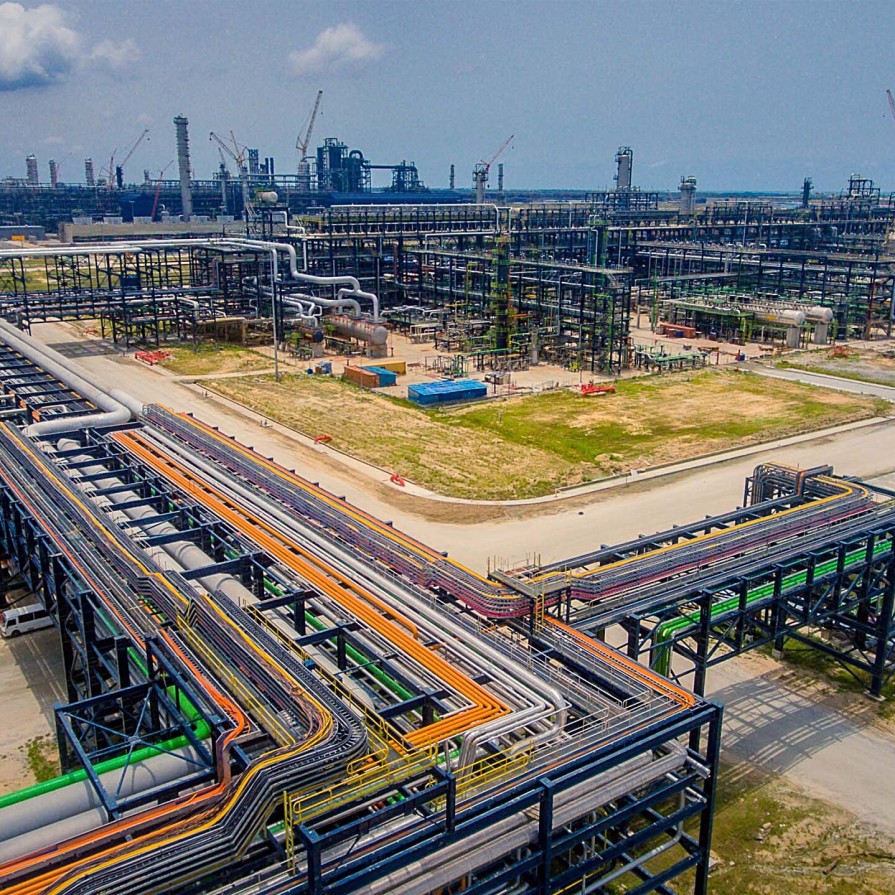
Dangote Lekki: Africa's Oil Refinery Reshaping Global Energy Markets
The Dangote Lekki refinery, with its current capacity of 700,000 barrels per day (b/d), has been operating at maximum capacity for the past two months. This has significantly boosted product exports to Europe and surpassed traditional suppliers from the Gulf region and the United States. The rise of Dangote has reshaped West African fuel trade, with imports of clean products from the region decreasing by nearly 25% year-on-year in Q2.
However, Dangote views this merely as the beginning. The company plans to add another crude distillation unit (CDU), increasing total capacity to 1.45 million barrels per day and building extensive storage and distribution infrastructure across Africa.
Initial Success and Expansion Plans
Recent maintenance and upgrades at the refinery have increased capacity from 650,000 barrels per day to 700,000 barrels per day by addressing bottlenecks in the existing crude distillation unit. This capacity upgrade took approximately 2.5 years to complete, with regular crude oil purchases beginning in March 2024.
The next phase will be significantly larger. Dangote aims to complete mechanical completion for a new 750,000 barrels per day CDU and additional secondary units by December 2028. This may include an additional vacuum distillation unit as well as expansions to polypropylene, base oil, and linear alkylbenzene capacity.
If completed, this project would transform Lekki into the world's largest refinery with a capacity of 1.45 million barrels per day, surpassing Reliance Industries' 1.4 million barrels per day Jamnagar complex in India.
| Dangote Lekki Refinery Project | Specifications |
|---|---|
| Current Capacity | 700,000 barrels per day |
| Target Capacity | 1.45 million barrels per day |
| Recent Upgrade Duration | 2.5 years |
| Projected Completion Date for New CDU | December 2028 |
| Global Position Upon Completion | World's Largest Refinery |
Timeline Challenges and Competition
However, the construction of Dangote's first CDU took eight years, comparable to the pace of other recent refinery projects. For instance, the newly commissioned Barmer refinery in Rajasthan, India, also took approximately eight years to build despite being significantly smaller with a capacity of 180,000 barrels per day.
This makes Dangote's target of completing its second CDU by 2028 appear unrealistic. Nevertheless, the timeline may be more significant for the signal it sends. While the Nigerian National Petroleum Corporation (NNPC) is still attempting to upgrade its three refineries with a combined capacity of 445,000 barrels per day by attracting external investors, Dangote's promise to build the world's largest refinery sends a clear message to both NNPC and potential investors.
Crude Oil Supply Strategy
The refinery primarily relies on Nigerian crude oil, but domestic supplies are insufficient to meet full demand. Crude intake peaked at nearly 650,000 barrels per day in May before falling to 575,000 barrels per day in June.
Nigeria's Bonny Light remains the primary crude grade, while WTI Midland from the U.S. Gulf of Mexico averaged 120,000 barrels per day in 2025 and reached up to 300,000 barrels per day in certain months. This combination of very light crudes supports high jet fuel and diesel production but leaves too little residue to fully supply the plant's residue fluid catalytic cracker, limiting gasoline output.
Therefore, Dangote has expanded its crude slate to include heavier Nigerian grades such as Escravos, Forcados, and Bonga, along with occasional cargoes from Libya, Cameroon, Ghana, and Guyana. The shift to a more balanced mix of light and medium crudes allows for more gasoline and diesel production, with prospects for increased exports.
Export Success and European Market Shifts
Product exports have been the refinery's most notable success to date. Nearly half of Dangote's product loadings in June were jet fuel, reaching a record 145,000 barrels per day. Most of that volume went to Europe, with 67%, approximately 96,000 barrels per day, destined for the Netherlands and the broader Amsterdam-Rotterdam-Antwerp (ARA) region.
The destination mix has also shifted dramatically. Last month, the United Kingdom accounted for about half of Dangote's jet fuel exports, equivalent to seven cargoes or approximately 60,000 barrels per day. Once a pioneer in importing Dangote jet fuel, flows to the UK have decreased to just two cargoes, about 10,000 barrels per day, as ARA has become the primary export destination for the refinery.
| Dangote Jet Fuel Exports (June 2025) | Volume (barrels per day) | Key Destinations |
|---|---|---|
| Total Export Volume | 145,000 | 50% of total products |
| Bound for Europe | 145,000 | 100% of total volume |
| Bound for ARA | 96,000 | 67% of total volume |
| Bound for UK | 10,000 | Down from 60,000 barrels per day |
This is significant as ARA has historically relied mainly on suppliers from the Gulf region, particularly Kuwait, along with India. During the crisis period in April and May, the U.S. became Europe's largest jet fuel supplier, sending about 135,000 barrels per day in April and 155,000 barrels per day in May. These flows decreased in June as the jet fuel premium to ICE Brent collapsed from around $90/barrel in April to $40/barrel by late June.
Regional Expansion Strategy
Diesel exports have been more focused on the region, primarily moving to neighboring African markets. Along with Dangote's other clean products, they have helped reduce West Africa's dependence on external suppliers. In 2024 and 2025, Belgium, the Netherlands, Spain, India, and Russia were among the main sources of clean product imports to the region.
Over the past six months, this model has been restructured, with Nigeria emerging as a regional hub. The commercial logic for the next regional expansion is compelling. Eleven West African countries have no refineries, while Ghana's effective capacity is only about 68,000 barrels per day but is currently operating at half its nominal capacity, and Senegal's SAR refinery primarily serves the domestic market.
Deeper barriers are distribution. Limited storage, road transport dominance, and long domestic transit times increase costs. Dangote's planned 1.6 million barrel gasoline and diesel storage center in Walvis Bay, Namibia, is designed to address that issue, potentially serving Botswana, Zimbabwe, and Zambia. There are even reports that Dangote Group agencies are considering it might eventually reach South Africa.
South Africa would be the prize. Its 405,000 barrel per day fuel market is only about 25% supplied by domestic production, leaving most demand met by imports from India, Oman, and Saudi Arabia. South Africa's steady demand for clean products would provide Dangote with a stable customer base while potentially reducing regional fuel costs.
Future Projects and Challenges
However, the planned pipeline network faces security and execution risks that have complicated other infrastructure projects on the continent. Dangote has rejected Nigeria's domestic product pipelines for security reasons, instead relying on LNG-powered trucks. Therefore, sea-based distribution from Lekki or a future Walvis Bay hub may prove more practical than an extensive cross-border pipeline system.
The company is also considering a 700,000 barrels per day refinery in Mombasa, Kenya, a project estimated at $17 billion and expected to take about 5 years to build. Despite that development, whether both Lekki's second CDU and the regional logistics network proceed on schedule remains uncertain.
Dangote has demonstrated that a single refinery can redraw African fuel flows and challenge established suppliers in Europe. The next phase will test whether Aliko Dangote can translate that operational success into a continental refining and distribution system without being derailed by security risks, uneven infrastructure, and fluctuating product demand.
By Natalia Katona for Oilprice.com