Green Finance and Technology Advancements in Vietnam's Energy Sector
In a significant development for Vietnam's sustainable energy transition and industrial modernization, two major announcements highlight the country's progress in green finance and advanced manufacturing technologies. Verdant Energy has successfully issued a green bond worth 792 billion VND to support rooftop solar power projects, while Rosatom and Petrovietnam have partnered to establish Vietnam's first 3D printing center for the oil and gas industry. These initiatives signal important steps toward Vietnam's climate goals and technological self-reliance.
Verdant Energy Issues 792 Billion VND Green Bond to Boost Rooftop Solar Power in Vietnam
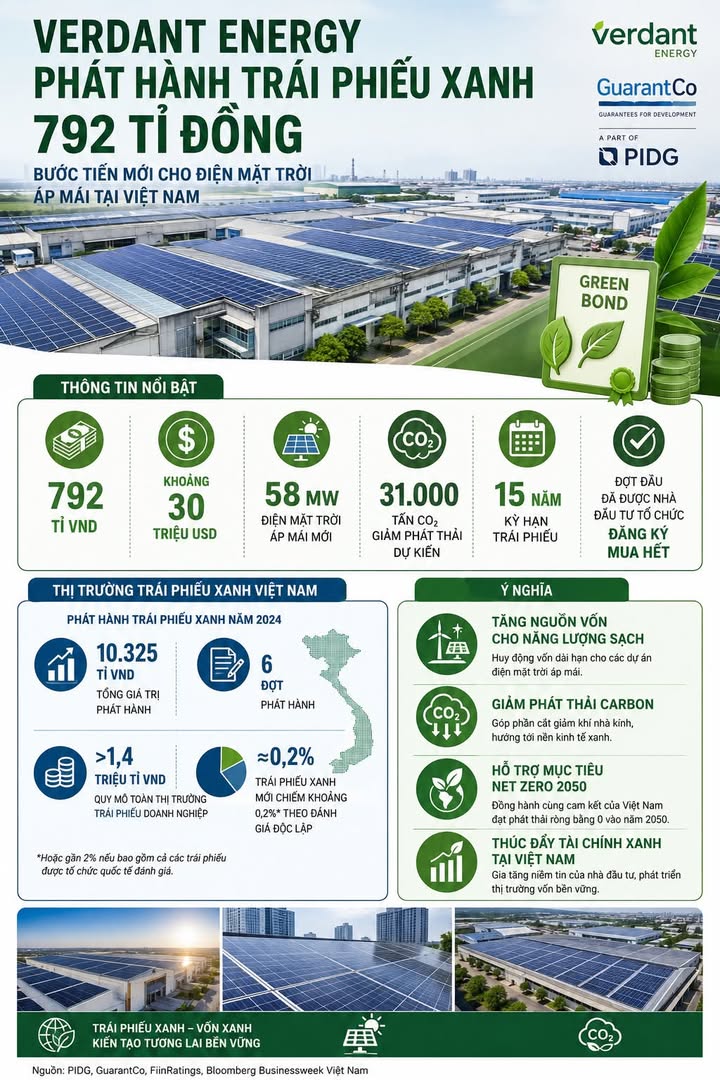
The successful issuance of a green bond worth 792 billion VND (approximately 30 million USD) by Verdant Energy marks a significant milestone for Vietnam's green finance market. This bond, guaranteed by GuarantCo, represents the first certified green bond issuance in Vietnam specifically dedicated to rooftop solar power projects serving commercial and industrial customers.
The raised capital will be used to develop approximately 58 MW of additional rooftop solar capacity. According to projections, these projects will help reduce approximately 31,000 tons of CO2, contributing to Vietnam's emission reduction goals and supporting the transition to clean energy.
This issuance is particularly noteworthy as it marks Verdant Energy's first fundraising through the bond market. The bond, along with its guarantee, has a maturity of up to 15 years, reflecting the long-term investment nature of renewable energy infrastructure projects. The first issuance was fully subscribed by domestic institutional investors, primarily insurance companies.
Verdant Energy, headquartered in Singapore and backed by the A.P. Moller Capital fund, currently operates approximately 39 MW of rooftop solar capacity in Vietnam for various commercial and industrial clients including Central Retail, Delson Technology, and Hong Fu. Following this new fundraising, the company's total project capacity is expected to expand significantly.
Beyond Verdant Energy's transaction, GuarantCo has previously guaranteed green bond issuances by EVNFinance, AquaOne, I.D.I Sao Mai, and Bình Thuận Plastic Group, indicating a growing trend of green finance expanding across various sectors.
| Parameter | Value |
|---|---|
| Issuance Value | 792 billion VND |
| Converted Value | Approximately 30 million USD |
| New Solar Capacity | 58 MW |
| Existing Capacity in Vietnam | 39 MW |
| Expected Emission Reduction | Approximately 31,000 tons CO2 |
| Bond Tenure | Up to 15 years |
Market Context and Future Prospects
Despite emerging transactions, Vietnam's green bond market remains in its early stages. According to 2024 data, total green bond issuance reached approximately 10,325 billion VND across six issuances—the highest volume to date but still representing a very small portion of the overall corporate bond market.
| Market Segment | Value |
|---|---|
| 2024 Green Bond Issuance | 10,325 billion VND |
| Total Corporate Bond Market Size | Over 1,400,000 billion VND |
| Green Bond Share (independent assessment) | Approximately 0.2% |
| Green Bond Share (including international assessment) | Nearly 2% |
The substantial gap between green bond issuance and the overall market indicates significant growth potential. If guarantee mechanisms, certification standards, and supportive policies continue to improve, green finance could become a crucial driver for expanding renewable energy investment in Vietnam, reducing emissions, and enhancing access to long-term capital for sustainable development projects.
Rosatom and Petrovietnam Collaborate to Establish Vietnam's First 3D Printing Center for Oil and Gas Industry
In a strategic move to enhance Vietnam's industrial capabilities and reduce dependency on imported components, Petrovietnam and Rosatom have signed a memorandum of understanding to develop additive manufacturing technology in Vietnam. The collaboration aims to establish a dedicated 3D printing center primarily serving the oil and gas industry, representing a technologically significant partnership that will transfer not just equipment but a complete ecosystem including software, materials, workforce training, and technical support.
According to the plan, the center will produce complex mechanical components for offshore rigs, pumps, pipeline systems, and various industrial equipment. Metal 3D printing technology will enable domestic production of replacement parts, significantly reducing waiting times for imported components and minimizing prolonged equipment downtime.
An important advantage of additive manufacturing technology is its ability to reproduce discontinued components or produce large-sized parts that are difficult to source internationally. This is particularly valuable for oil and gas facilities operating for many years where original equipment manufacturers may no longer provide genuine spare parts.
| Project Aspect | Details |
|---|---|
| Partners | Rosatom and Petrovietnam |
| Field | Additive manufacturing, metal 3D printing |
| Objective | Establish a 3D printing center in Vietnam |
| Initial Phase | Production process audit and equipment needs assessment |
| Survey Timeline | July 2026 |
| Expected Operation | 2027 |
| Support Scope | 3D printers, software, materials, training, technology transfer |
Comprehensive Technology Transfer and Future Vision
Notably, Rosatom's involvement extends beyond providing equipment to encompass comprehensive technology transfer. Russian experts will directly evaluate Petrovietnam's existing production lines before determining the center's configuration, quantity of 3D printers, suitable materials, and optimized production processes.
If implemented as scheduled, Vietnam could gradually develop domestic high-tech industrial component manufacturing capabilities, reducing dependence on foreign supply sources. This would not only reduce logistics costs but also enhance response capabilities when technical failures occur at offshore oil and gas facilities.
Rosatom has successfully implemented similar technology centers in Belarus and provided industrial 3D printers to the aerospace sector in India. This experience is expected to streamline implementation in Vietnam and improve operational efficiency from the initial phase.
Looking ahead, the parties are also considering the possibility of assembling Russian 3D printers in Vietnam. If realized, Vietnam could not only meet domestic demand but also potentially become a supplier of industrial 3D equipment and solutions to the Southeast Asian market, opening new development opportunities for Vietnam's mechanical engineering and supporting industries in the region.
Conclusion: Toward a Sustainable and Technologically Independent Future
These two developments—Verdant Energy's green bond issuance and the Rosatom-Petrovietnam 3D printing collaboration—reflect Vietnam's dual approach to sustainable development: leveraging international finance for clean energy transition while building domestic technological capabilities to support industrial growth.
The green bond market, though currently small, shows promising potential to channel significant capital into Vietnam's renewable energy goals. Meanwhile, the adoption of advanced manufacturing technologies like 3D printing could revolutionize Vietnam's industrial landscape, reducing dependency on imported components and fostering innovation in the oil and gas sector and beyond.
As Vietnam continues to position itself as an emerging economy committed to both sustainable development and technological advancement, these initiatives represent important steps toward achieving its climate targets and industrial modernization objectives.