Nuclear Inspections in Iran Enter Critical Phase as Access Rights Determine Future of Non-Proliferation Agreement
In the ongoing tense relationship between the United States and Iran, the most pressing question has shifted from whether Iran will accept inspections to the extent of access international inspectors will have to verify the country's nuclear program. This factor is now considered decisive in determining the ability to maintain the nuclear non-proliferation agreement in the coming period.
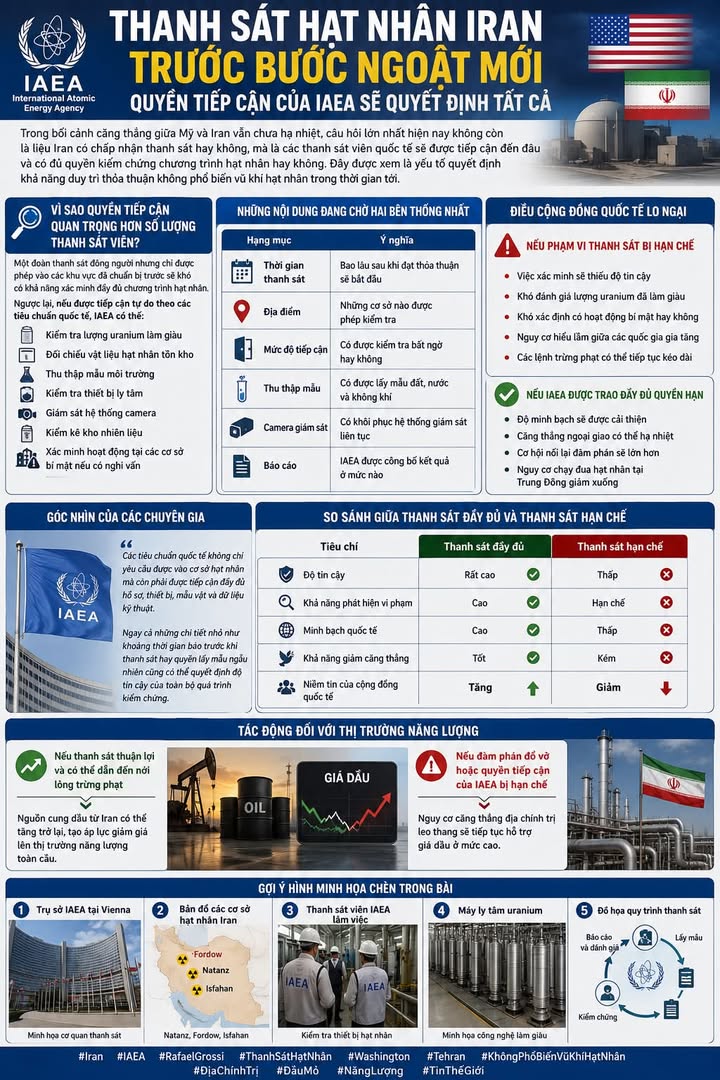
Iran's Nuclear Inspections Face New Crossroads as IAEA Access Will Determine Everything
After weeks of debate between Washington and Tehran over whether the international community can fully verify Iran's nuclear commitments, the issue is gradually moving to a technical phase with significant strategic implications.
International Atomic Energy Agency (IAEA) Director General Rafael Grossi has indicated that the organization will soon work with Iran to agree on key aspects including timing, procedures, and locations for inspections. However, according to numerous former officials involved in international nuclear control programs, the success of any inspection mission depends not on whether inspectors are present, but on the scope of authority they are permitted to exercise.
Why Access Rights Matter More Than Number of Inspectors
A large inspection team with limited access to pre-approved areas would have difficulty fully verifying a nuclear program. Conversely, if granted free access according to international standards, the IAEA could:
- Inspect enriched uranium quantities
- Verify nuclear material inventory
- Collect environmental samples
- Inspect centrifuge equipment
- Monitor camera systems
- Inventory fuel storage facilities
- Verify activities at suspected secret sites
Key Items Pending Agreement Between Both Parties
| Category | Significance |
|---|---|
| Inspection Timing | How long after reaching an agreement inspections will begin |
| Locations | Which facilities will be permitted for inspection |
| Level of Access | Whether surprise inspections will be allowed |
| Sample Collection | Whether samples of soil, water, and air can be taken |
| Monitoring Cameras | Whether continuous monitoring systems will be restored |
| Reporting | At what level IAEA results will be disclosed |
International Community's Concerns
If inspection scope is limited:
- Verification reliability will be compromised
- It will be difficult to assess the amount of enriched uranium
- It will be challenging to identify secret activities
- Risk of misunderstanding between nations increases
- Sanctions may continue indefinitely
If IAEA is granted full authority:
- Transparency will improve
- Diplomatic tensions could ease
- Opportunities for resuming negotiations will increase
- Risk of nuclear arms race in the Middle East decreases
Expert Perspectives
Many former inspectors note that international standards require not just access to nuclear facilities but also full access to records, equipment, samples, and technical data. Even small details such as advance notice for inspections or rights to random sampling can determine the reliability of the entire verification process.
Comparison Between Full and Limited Inspections
| Criteria | Full Inspections | Limited Inspections |
|---|---|---|
| Reliability | Very High | Low |
| Ability to Detect Violations | High | Limited |
| International Transparency | High | Low |
| Ability to Reduce Tensions | Good | Poor |
| International Community Trust | Increases | Decreases |
Impact on Energy Markets
Any positive signals from the inspection process could directly affect the oil market. If inspections proceed smoothly and pave the way for sanctions relief, Iranian oil supply could increase again, creating downward pressure on global energy prices. Conversely, if negotiations fail or IAEA access is significantly restricted, the risk of escalating geopolitical tensions will continue to support high oil prices.
If Iran Only Allows Partial Nuclear Inspections
The question arises: if Iran only permits inspection of partial nuclear facilities rather than the complete program as before, is the world moving closer to a new nuclear crisis? This scenario would create significant uncertainty in the international community and could potentially trigger a chain reaction of diplomatic and economic consequences.
The resolution of this inspection access issue will not only determine the fate of the nuclear agreement but could also have profound implications for global security, energy markets, and the geopolitical landscape of the Middle East. As negotiations continue, all eyes will be on whether Iran and the international community can reach an agreement that provides the IAEA with the necessary verification tools to ensure Iran's nuclear program remains peaceful.