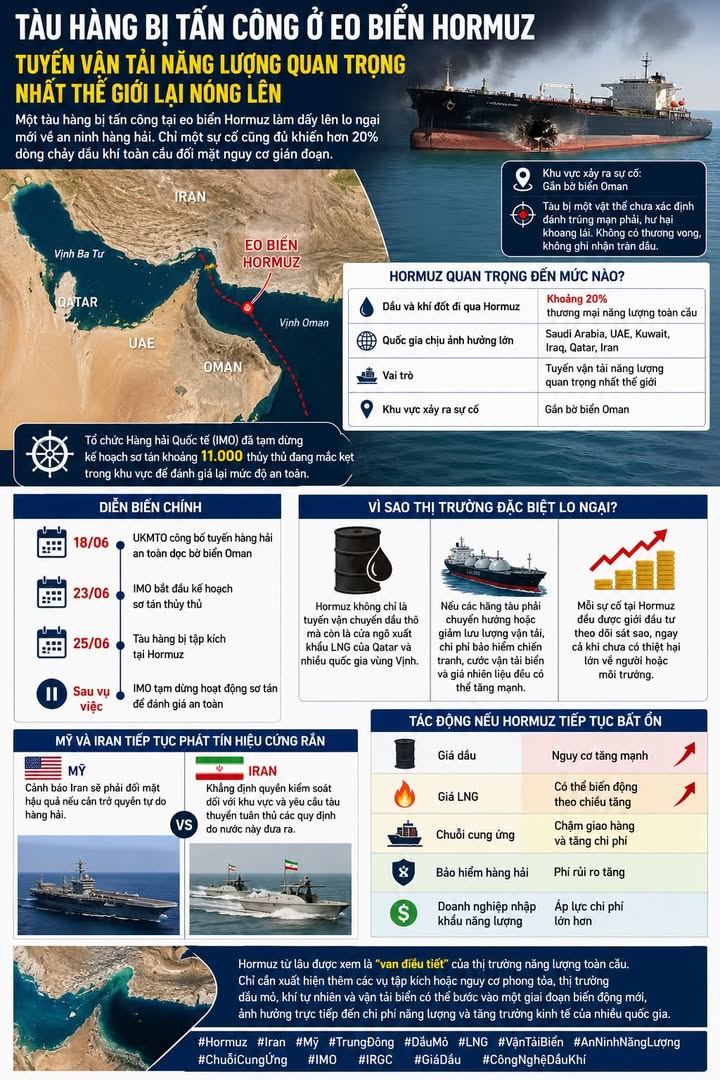
Attack on Merchant Vessel in Strait of Hormuz Reignites Tensions on World's Most Critical Energy Shipping Route
Strait of Hormuz, Middle East – A single attack on a merchant vessel has once again put the global energy supply at risk, with over 20% of worldwide oil and gas flows potentially facing disruption. If tensions in the Strait of Hormuz continue to escalate, oil prices could surge, and the entire world may face economic consequences.
An attack on a commercial vessel in the Strait of Hormuz has intensified tensions in international maritime and energy markets. According to released information, the vessel was struck on its starboard side by an unidentified object, causing damage to the bridge area but no reported casualties or oil spills.
Security sources indicate that the vessel may have been targeted by a drone attack while navigating near the coast of Oman.
Notably, the incident occurred just hours after Iran's Islamic Revolutionary Guard Corps (IRGC) announced that all vessels must comply with shipping lanes declared by Iran and warned that it would handle vessels deemed to be violating regulations.
The Critical Importance of the Strait of Hormuz
| Metric | Value |
|---|---|
| Oil and gas passing through Hormuz | Approximately 20% of global energy trade |
| Major affected countries | Saudi Arabia, UAE, Kuwait, Iraq, Qatar, Iran |
| Strategic importance | World's most critical energy shipping route |
| Location of incident | Near the coast of Oman |
Following the incident, the International Maritime Organization (IMO) temporarily suspended plans to evacuate approximately 11,000 sailors stranded in the area to reassess safety levels.
This decision indicates that maritime security risks are escalating more rapidly than previously anticipated.
Key Developments in the Crisis
| Date | Event |
|---|---|
| June 18 | UKMTO announced safe shipping lanes along Oman's coast |
| June 23 | IMO began plans to evacuate sailors |
| June 25 | Merchant vessel attacked in Hormuz |
| Post-incident | IMO suspended evacuation activities to assess safety |
Why Markets Are Particularly Concerned
The Strait of Hormuz serves not only as a crude oil transportation route but also as the export gateway for LNG from Qatar and numerous Gulf countries.
If shipping companies are forced to change routes or reduce shipping volumes, war insurance costs, freight rates, and fuel prices could all increase significantly.
This is why every incident in Hormuz is closely monitored by investors, even when there are no major casualties or environmental damages.
US and Iran Continue to Exchange Tough Signals
While the US has warned Iran that it will face consequences if it impedes freedom of navigation, Tehran continues to assert control over the area and demands that vessels comply with regulations issued by Iran.
The differing viewpoints between the two sides maintain the risk of continued tensions on this strategically important maritime route.
Potential Impacts if Hormuz Remains Unstable
| Sector | Potential Impact |
|---|---|
| Oil prices | Risk of significant increases |
| LNG prices | Possible upward fluctuations |
| Supply chain | Delayed deliveries and increased costs |
| Marine insurance | Higher risk premiums |
| Energy importing businesses | Greater cost pressures |
The Strait of Hormuz has long been considered the "regulating valve" of the global energy market. The emergence of additional attacks or the risk of blockades could push the oil, natural gas, and maritime shipping markets into a new period of volatility, directly affecting energy costs and economic growth in many countries.
The international community continues to monitor the situation closely, with hopes that diplomatic channels can prevent further escalation in this strategically vital waterway.