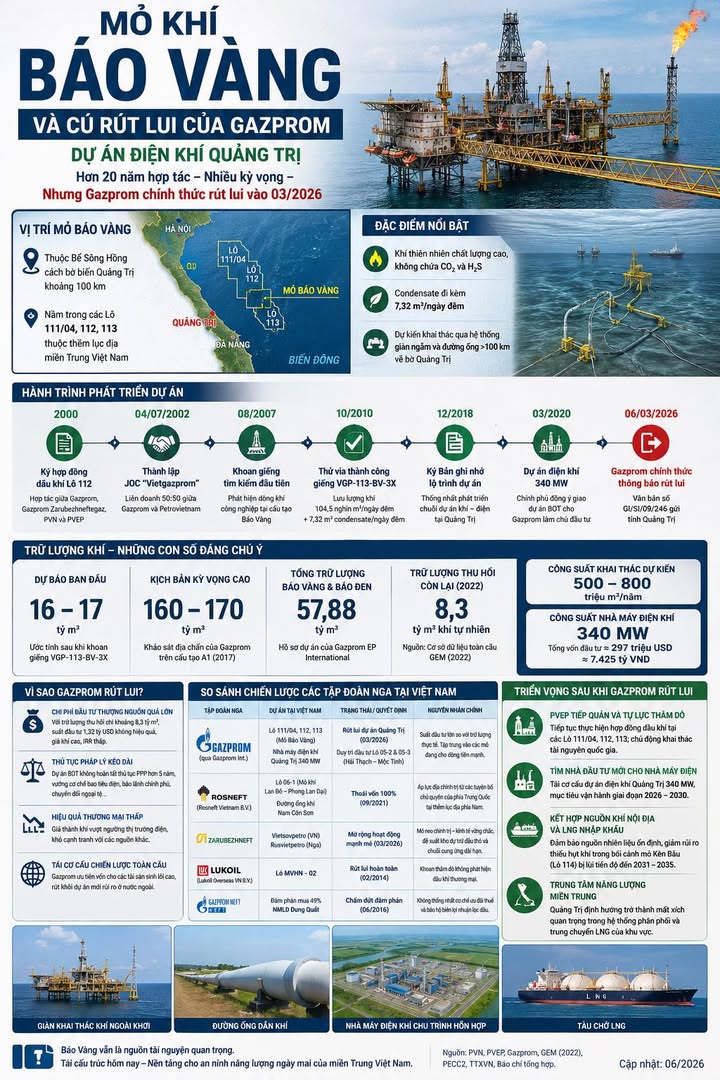
Gazprom's Withdrawal from Bao Vang Gas Field: Lost Opportunity or Strategic Realignment?
The abrupt withdrawal of energy giant Gazprom from the Bao Vang gas field project in Quang Tri province marks a significant turning point in Vietnam's energy landscape. After more than two decades of development, the Russian conglomerate's departure raises critical questions about the project's commercial viability, Vietnam's gas power development framework, and the future of energy development in central Vietnam.
The Promise of Bao Vang: A Vision for Central Vietnam's Energy Future
Once envisioned as a cornerstone of Quang Tri's transformation into an energy hub for central Vietnam, the Bao Vang gas field represented more than just a hydrocarbon discovery. It symbolized a comprehensive energy development plan that included offshore gas extraction, onshore processing infrastructure, and a 340 MW gas-fired power plant capable of powering industrial growth and enhancing regional energy security.
The project's technical specifications presented an attractive profile:
| Parameter | Specification |
|---|---|
| Location | Offshore Quang Tri, Song Hong Basin |
| Distance to Shore | 100-120 km |
| Discovering Entity | Vietgazprom Joint Venture |
| Test Gas Flow | Approximately 104,500 m³/day |
| Test Condensate | Approximately 7.32 m³/day |
| Gas Composition | No CO2 and H2S (clean gas) |
| Planned Power Plant | Quang Tri Gas Power Plant (340 MW) |
| Total Investment | Approximately 7,425 billion VND ($297M) |
The most significant technical advantage of Bao Vang was the exceptional quality of its gas—free from carbon dioxide (CO2) and hydrogen sulfide (H2S). This characteristic reduced processing requirements, minimized pipeline corrosion risks, and enhanced the project's technical attractiveness compared to other gas fields in the region.
A Journey of Two Decades: The Evolution of the Project
The Bao Vang project's development spanned over 20 years, marked by key milestones that reflected both progress and challenges:
- 2000: Petroleum contract for Block 112 signed between Vietnam and Gazprom
- July 4, 2002: Vietgazprom established with 50-50 cooperation structure
- August 2007: Industrial gas flow successfully recorded during drilling operations
- October 2010: Successful test of VGP 113 BV 3X well confirming commercial viability
- December 2018: Development roadmap signed for Bao Vang gas field cluster and Quang Tri gas power project
- 2020: Gazprom formally assigned to develop the 340 MW Quang Tri gas power plant
- March 6, 2026: Gazprom announced official withdrawal from the integrated Bao Vang and power project
This timeline reveals a project that progressed through initial discovery and testing to comprehensive planning, only to face an abrupt conclusion at the implementation stage. The extended development period—spanning more than two decades—highlighted both the technical challenges and the procedural complexities that ultimately contributed to Gazprom's decision to withdraw.
The Reserve Conundrum: Expectations vs. Reality
Perhaps the most critical factor in Gazprom's withdrawal was the significant discrepancy between initial reserve estimates and the more conservative assessments that emerged over time. This gap between expectation and reality created fundamental economic challenges for the project:
| Reserve Scenario | Estimated Volume | Commercial Implications |
|---|---|---|
| Initial Assessment | 16-17 billion m³ | Sufficient for small-scale gas power project |
| High Expectation Scenario | 160-170 billion m³ | Created high expectations for Quang Tri's industrial development |
| Bao Vang and Bao Den Cluster | Approximately 57.88 billion m³ | Integrated cluster development perspective |
| Remaining Recoverable Reserves | Approximately 8.3 billion m³ | Made economic equation very challenging |
The stark reality of approximately 8.3 billion m³ of remaining recoverable reserves—significantly below initial optimistic projections—created a fundamental economic challenge. When combined with the substantial capital requirements for offshore extraction infrastructure, over 100 km of pipelines, and power generation facilities, the project's economics became increasingly unattractive.
Multifaceted Challenges Leading to Withdrawal
Gazprom's decision to withdraw from the Bao Vang project was not based on a single factor but rather resulted from multiple overlapping challenges:
- Reserve Insufficiency: The gap between initial expectations and actual recoverable reserves significantly reduced the project's financial attractiveness
- High Upstream Investment: The substantial capital required for offshore extraction and long-distance pipeline infrastructure pushed the break-even gas price to uncompetitive levels
- Procedural Delays: Investment procedures extending beyond five years disrupted the project's commercial timeline
- Market Uncertainty: Unclear power purchase agreements and government guarantees increased investment risks
- Strategic Realignment: Gazprom's global portfolio restructuring prioritized assets with more stable cash flows and clearer returns
These challenges created a perfect storm that made the Bao Vang project increasingly difficult to justify within Gazprom's global investment portfolio, particularly as the company faced mounting pressure to optimize returns amid global geopolitical shifts.
Russian Energy Companies in Vietnam: Divergent Strategies
The Bao Vang withdrawal should be viewed within the broader context of Russian energy companies' operations in Vietnam, which reveal varying strategic approaches and outcomes:
| Company | Project in Vietnam | Status | Key Factor |
|---|---|---|---|
| Gazprom | Bao Vang and Quang Tri Power | Withdrawing | Economic viability concerns |
| Rosneft | Block 06-1 and Nam Con Son | Withdrew | Geopolitical pressure and asset strategy |
| Zarubezhneft | Vietsovpetro | Continuing expansion | Long-term partnership and stable cash flow |
| Lukoil | Block MVHN 02 | Withdrew | Unsuccessful commercial results |
| Gazprom Neft | Dung Quat negotiations | Terminated | Failed to reach agreement on incentives |
Notably, Gazprom's withdrawal from Quang Tri doesn't signify a complete exit from Vietnam. The company continues its partnership with Petrovietnam in other assets, particularly the Hai Thach Moc Tinh area, which offers clearer production profiles and more stable cash flows. This selective approach suggests Gazprom is strategically optimizing its portfolio rather than retreating from the Vietnamese market entirely.
Future Pathways for Bao Vang: Restructuring Opportunities
With Gazprom's withdrawal, Bao Vang faces an uncertain but potentially transformative future. Several restructuring scenarios could breathe new life into the project:
- PVEP Upstream Takeover: Petrovietnam Exploration and Production Corporation (PVEP) could assume control of upstream operations, maintaining national resource sovereignty while requiring significant capital and implementation capabilities
- New Power Investor: Identifying a new investor for the 340 MW power plant component could restart the downstream element of the project, though this depends on resolving power pricing and purchase mechanisms
- Hybrid Gas-LNG Model: Combining Bao Vang's domestic gas with imported liquefied natural gas (LNG) could create a more flexible and reliable fuel supply for the power plant, requiring additional import infrastructure
- Strategic Delay: A cautious approach avoiding hasty decisions might prevent suboptimal outcomes but risks missing opportunities outlined in Vietnam's Power Development Plan VIII
The most promising approach may involve a hybrid model that leverages Bao Vang's existing infrastructure while incorporating LNG to ensure fuel security and economic viability. This approach would require careful coordination between upstream development, import infrastructure, and power generation planning.
Broader Implications for Vietnam's Energy Strategy
The Bao Vang project's challenges reflect broader questions about Vietnam's approach to gas power development:
- Reserve Assessment Realism: The project highlights the need for more conservative reserve estimates that account for economic extraction constraints rather than just geological potential
- Investment Framework Reform: Complex and lengthy approval processes may deter investment in Vietnam's energy sector, requiring streamlined mechanisms for strategic projects
- Power Pricing Mechanisms: Clear and economically viable power purchase agreements are essential to attract investment in gas power infrastructure
- Energy Security Balance: Vietnam must balance the desire for domestic energy security with economic realities, potentially adopting a diversified approach combining domestic resources with imported LNG
- Strategic Resource Allocation: The experience suggests Vietnam should prioritize gas development in fields with clearer economics and proximity to demand centers
Conclusion: Beyond the Withdrawal
Gazprom's withdrawal from the Bao Vang project represents more than just a single company's strategic decision—it reflects the complex interplay between geological realities, economic constraints, and investment frameworks in developing Vietnam's energy resources.
The project's transformation from a promising energy venture to a challenging case study underscores a fundamental truth in energy development: technical success does not guarantee commercial viability. For Quang Tri and Vietnam, the lesson is not to abandon gas development but to approach it with more realistic assessments, streamlined processes, and flexible business models.
The Bao Vang story ultimately serves as a valuable case study for Vietnam's energy planners, highlighting both the opportunities and pitfalls in developing domestic gas resources. How Vietnam responds to this challenge will likely shape the country's energy landscape for decades to come, potentially determining whether central Vietnam can fulfill its promise as an energy hub or remain a region of unrealized potential.