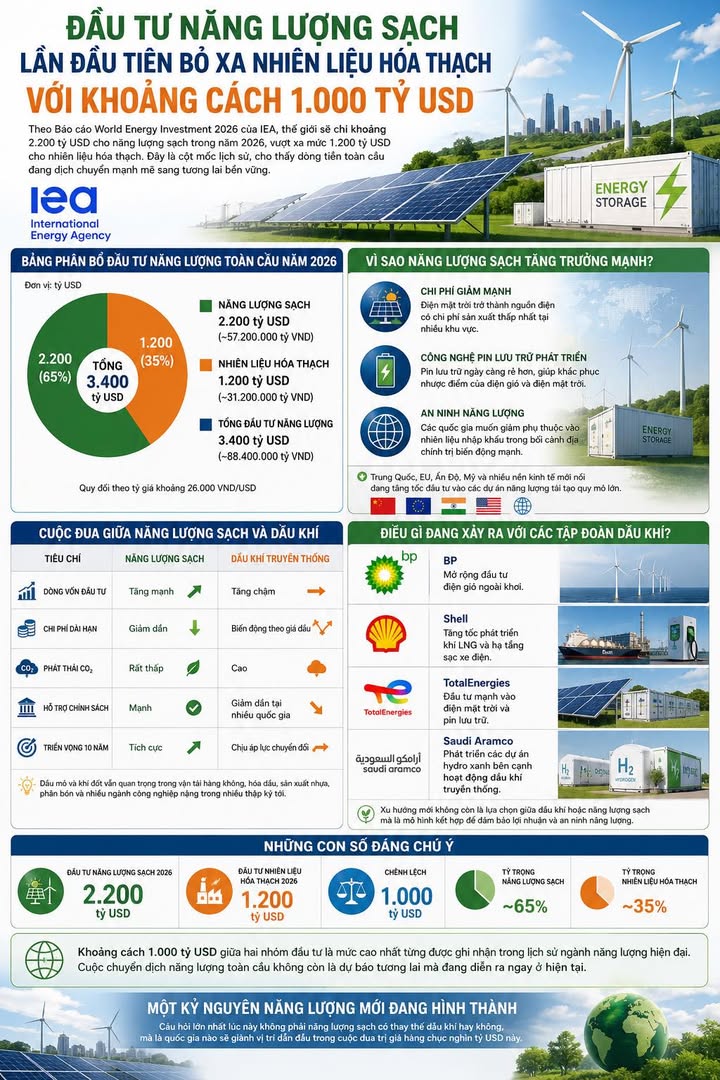
Clean Energy Investment Surpasses Fossil Fuels by $1 Trillion in Historic Shift
The world is investing over $2.2 trillion in clean energy while oil and gas receive only about $1.2 trillion, signaling what may be an irreversible decline for the fossil fuel industry. According to the International Energy Agency's (IEA) World Energy Investment 2026 report, this represents a historic milestone in global energy investment patterns.
This shift in investment allocation reflects not just changing financial flows but also profound transformations in energy security strategies, economic development approaches, and emission reduction goals worldwide. The approximately $1 trillion gap between clean energy and fossil fuel investments marks the largest such divergence in modern energy history.
Global Energy Investment Allocation for 2026
| Category | Value (USD) | Value (VND) |
|---|---|---|
| Clean Energy | $2.2 trillion | 57,200,000 billion VND |
| Fossil Fuels | $1.2 trillion | 31,200,000 billion VND |
| Total Energy Investment | $3.4 trillion | 88,400,000 billion VND |
Exchange rate used: approximately 26,000 VND/USD.
Why Clean Energy is Growing Rapidly
Three major drivers are fueling this new wave of investment:
- Solar Power Dominance: Solar energy has become the lowest-cost power generation option in many regions, making it economically attractive without subsidies.
- Declining Battery Storage Costs: Energy storage technology is becoming increasingly affordable, helping to overcome the intermittency challenges of wind and solar power.
- Energy Security Concerns: Countries are seeking to reduce dependence on imported fuels amid significant geopolitical uncertainties and volatility in global energy markets.
China, the European Union, India, the United States, and other emerging economies are all accelerating investments in large-scale renewable energy projects. This coordinated push is creating economies of scale that further drive down costs and accelerate deployment.
The Clean Energy vs. Fossil Fuels Competition
| Criteria | Clean Energy | Traditional Oil & Gas |
|---|---|---|
| Investment Flow | Strong growth | Slow growth |
| Long-term Costs | Gradually decreasing | Fluctuating with oil prices |
| CO2 Emissions | Very low | High |
| Policy Support | Strong | Declining in many countries |
| 10-Year Outlook | Positive | Facing transition pressures |
However, this shift doesn't mean fossil fuels will disappear completely. According to energy experts, oil and gas will continue to play important roles in aviation, petrochemicals, plastics production, fertilizers, and heavy industries for decades to come.
What's Happening with Major Oil Companies
Many "big energy" players are fundamentally changing their strategies:
- BP is expanding investment in offshore wind energy.
- Shell is accelerating the development of LNG infrastructure and electric vehicle charging networks.
- TotalEnergies is investing heavily in solar power and battery storage.
- Saudi Aramco is developing green hydrogen projects alongside traditional oil and gas operations.
The new paradigm is no longer a choice between oil and gas or clean energy, but rather a hybrid model designed to ensure profitability and energy security in a rapidly changing global landscape.
Notable Statistics
| Indicator | Value |
|---|---|
| Clean Energy Investment 2026 | $2.2 trillion |
| Fossil Fuel Investment 2026 | $1.2 trillion |
| Investment Gap | $1 trillion |
| Clean Energy Share | Approximately 65% |
| Fossil Fuel Share | Approximately 35% |
The $1 trillion investment gap between the two sectors represents the largest divergence ever recorded in modern energy history. This indicates that the global energy transition is no longer a future prediction but is happening right now. Countries that control technologies related to batteries, solar power, wind energy, smart grids, and energy storage are likely to hold the greatest competitive advantages in the global economy for decades to come.
A new energy era is taking shape. The most significant question today is not whether clean energy will replace fossil fuels, but which nations will secure leading positions in this race worth tens of trillions of dollars.