#NangLuong #DauMo #KhiDot #DaiLoan #Hormuz #AnNinhNangLuong #CongNgheDauKhi #KinhTe #TimKiemTop
If the global oil and gas shipping route is blocked for a few weeks, could a world-leading technology economy like Taiwan fall into an energy crisis just because it depends too much on imports?
In recent months, energy security has become a hot topic around the world. The crisis in the Strait of Hormuz has caused many countries to reconsider their dependence on imported energy sources as the risk of supply disruption becomes increasingly present.
Among developed economies, Taiwan is considered one of the most typical examples of external energy dependence. Although it is the world's leading semiconductor chip manufacturing center, this island has almost no significant energy resources.
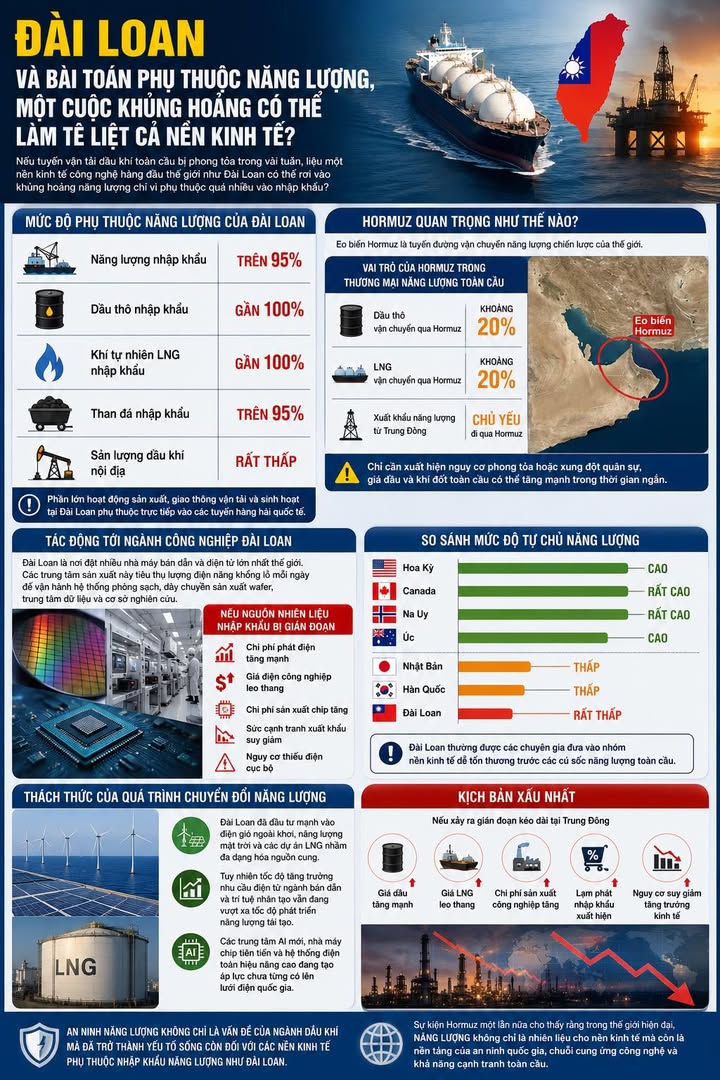
Taiwan's level of energy dependence
Estimated Target
Imported energy Over 95%
Imported crude oil Nearly 100%
Imported LNG natural gas Nearly 100%
Imported coal Over 95%
Domestic oil and gas production Very low
This means that pMost production, transportation and living activities in Taiwan depend directly on international maritime routes.
How important is Hormuz?
The Strait of Hormuz is the world's strategic energy transport route.
Hormuz's role in global energy trade
Category Global proportion
Crude oil transported through Hormuz About 20%
LNG transported via Hormuz About 20%
Energy exports from the Middle East mainly go through Hormuz
If there is a risk of blockade or military conflict, global oil and gas prices can increase sharply in a short time.
Impact on Taiwanese industry
Taiwan is home to many of the world's largest semiconductor and electronics factories.
These manufacturing centers consume huge amounts of electricity every day to operate clean room systems, wafer production lines, data centers and research facilities.
If imported fuel sources are interrupted
✅ Electricity generation costs increased sharply
✅ Industrial electricity prices escalated
✅ Chip production costs increase
✅ Export competitiveness declines
✅ Risk of local power shortage
Compare levels of energy autonomy
Country Energy autonomy level
United States Cao
Canada Very high
Norway Very high
Au Cao
Japan Thhamlet
Korea Low
Taiwan Very low
This is why Taiwan is often included by experts in the group of economies vulnerable to global energy shocks.
⚡ Challenges of the energy transition process
Over the years, Taiwan has invested heavily in offshore wind power, solar power and LNG projects to diversify its supply sources.
However, the growth rate of electricity demand from the semiconductor and artificial intelligence industries is still outpacing the growth rate of renewable energy.
New AI centers, advanced chip factories and high-performance computing systems are putting unprecedented pressure on the nation's power grid.
Worst scenario
If there is a prolonged disruption in the Middle East
Oil prices increased sharply
LNG prices escalated
Industrial production costs increase
Imported inflation appears
Risk of decline in economic growth
That is why energy security is no longer simply a matter of the oil and gas industry but has become a vital factor for energy import-dependent economies like Taiwan.
The Hormuz incident once again shows that in the modern world, energy is not only a fuel for the economy but also the foundation of national security, industrial supply chainstechnology and global competitiveness.
#Taiwan #Hormuz #AnNinhNangLuong #DauMo #LNG #KhiDot #ChipBanDan #CongNghe #KinhTeTheGioi #CongNgheDauKhi #TimKiemTop