Can a new offshore gas well save the declining field cluster, reduce hundreds of millions of dollars in investment costs and help Vietnam become less dependent on imported LNG?
Discovering oil and gas flow at exploration well RDM-1X in Block 11-2 not only adds more resources to PVEP but can also become an important link in the strategy to restore output in Nam Con Son Basin. The greatest value of this discovery lies in the ability to quickly connect to the existing Rong Doi mining system, thereby shortening mine development time, reducing investment capital and taking advantage of excess processing capacity.
RDM-1X appeared at a time when domestic output was under downward pressure
Many large oil and gas fields in Vietnam have entered a long period of stable exploitation, causing reservoir pressure and natural flow to gradually decrease over time. Meanwhile, gas demand for electricity production, fertilizer and industry continues to increase, forcing Vietnam to simultaneously promote domestic gas sources and expand LNG imports.
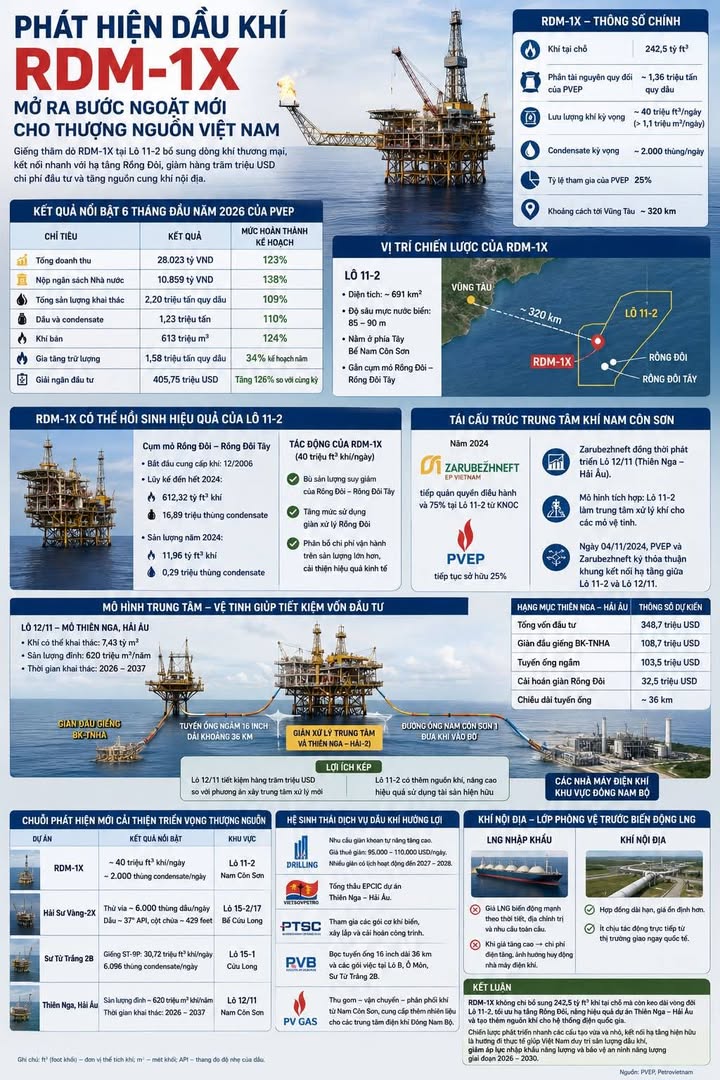
In that context, PVEP is accelerating exploration, appraisal and interventionwells to compensate for the amount of exploited resources. In the first six months of 2026, PVEP's total output will reach about 2.20 million tons of oil equivalent, up 34 percent over the same period in 2025 and completing 109 percent of the six-month plan.
Targets for the first six months of 2026 Results Plan completion level
Total revenue 28,023 billion VND 123 percent
Contributing to the State budget 10,859 billion VND 138 percent
Total exploitation output is 2.20 million tons equivalent to 109 percent oil
Oil and condensate 1.23 million tons 110 percent
Gas sales 613 million cubic meters 124 percent
Increased reserves of 1.58 million tons of oil, 34 percent of the year's plan
Investment disbursement 405.75 million USD, an increase of 126 percent over the same period
This result shows that PVEP not only maintains output at currently exploited mines but also accelerates the new investment cycle. Of the 14 wells expected to be deployed in 2026, the enterprise has completed construction of 5 wells, is drilling 2 wells and is preparing to deploy the remaining 7 wells in the second half of the year.
Outstanding technical value of the RDM-1X well
RDM-1X is located at the Rong Doi Moi structure in Block 11-2, the western area of Nam Con Son Basin, about 320 km southeast of Vung Tau. This oil and gas block has an area of about 691 square kilometers, sea level depthCommonly from 85 to 90 meters and located near the currently exploiting Rong Doi and Rong Doi Tay mine clusters.
Published technical data shows that the New Double Dragon formation has approximately 242.5 billion cubic feet of gas in place. With a 25 percent participation rate in Block 11-2, the equivalent resources attributable to PVEP are estimated at 1.36 million tons of oil equivalent.
The well is expected to be able to supply about 40 million cubic feet of gas per day, equivalent to more than 1.1 million cubic meters of gas per day, along with about 2,000 barrels of condensate per day. This is a significant flow rate for a declining field cluster because it can quickly replenish commercial gas sources without building a completely new processing center.
Main parameters of RDM-1X Estimated value
Gas in place 242.5 billion cubic feet
PVEP's equivalent resources are about 1.36 million tons of oil equivalent
Expected gas flow Approximately 40 million cubic feet per day
Condensate expected About 2,000 barrels per day
PVEP participation rate 25 percent
Distance to Vung Tau About 320 km
The most important point is the location of RDM-1X near Rong Doi infrastructure. If the appraisal results and commercial options continue to be favorable, the gas stream can be connected to the collection, treatment and transportation system.exists. This significantly reduces development costs compared to a stand-alone offshore field.
The new discovery could revive the economic efficiency of Block 11-2
The product sharing contract for Block 11-2 was signed in May 1992 and is expected to last until 2034. The Rong Doi and Rong Doi Tay fields began supplying gas in December 2006, but after many years of exploitation, it has entered a period of sharp decline.
By the end of 2024, the field cluster's accumulated output will reach about 612.32 billion cubic feet of gas and 16.89 million barrels of condensate. In 2024 alone, production will only be about 11.96 billion cubic feet of gas and 0.29 million barrels of condensate.
Reduced output causes operating costs per unit of gas to increase, while the Rong Doi central processing platform is not used at full capacity. Failure to achieve committed gas output can also create pressure from commercial obligations in gas purchase and transportation contracts.
In that context, about 40 million cubic feet of gas per day from RDM-1X could have three direct impacts. The first is to partially compensate for the decline in output of Rong Doi and Rong Doi Tay. The second is to increase the utilization of the existing treatment system. The third is to allocate operating costs over larger output, thereby improvingn economic efficiency of the entire project.
Zarubezhneft and PVEP are restructuring the Nam Con Son gas center
In 2024, Zarubezhneft EP Vietnam takes over operating rights and 75 percent participation in Block 11-2 from KNOC, while PVEP continues to own 25 percent.
The change of operator has special meaning because Zarubezhneft is also participating in the development of Block 12/11 located nearby, where the Thien Nga and Hai Au mine clusters are located. Instead of viewing the two oil and gas blocks as separate projects, the parties are aiming for an integrated development model, using Block 11-2 as a center to receive and process gas from satellite fields.
On November 4, 2024, PVEP and Zarubezhneft signed an infrastructure connection framework agreement between Lot 11-2 and Lot 11/12. The agreement paves the way for the transportation of Thien Nga and Hai Au gas flows through the underground pipeline to the Rong Doi central processing platform before being put into the Nam Con Son 1 pipeline system.
Central and satellite models help save investment capital
The Thien Nga and Hai Au project is planned to exploit about 7.43 billion cubic meters of gas in the period from 2026 to 2037. Peak output is expected to reach about 620 million cubic meters per year.
Instead of building an independent central processing platform, the project plans to use the BK- wellhead platform.TNHA, then transports the gas flow through a 16-inch underground pipeline about 36 km long to the Rong Doi platform.
Items Swans, Seagulls Expected parameters
Gas can exploit 7.43 billion cubic meters
Peak production is 620 million cubic meters per year
Exploitation time 2026 to 2037
Total investment capital is 348.7 million USD
BK-TNHA wellhead rig 108.7 million USD
Underground pipeline 103.5 million USD
Conversion of Rong Doi rig worth 32.5 million USD
Pipeline length: About 36 km
This model offers dual benefits. Block 11/12 avoids the cost of building a completely new processing system, while Block 11-2 has an additional gas source to maintain the operation of the Rong Doi platform. When RDM-1X output is combined with gas from Thien Nga and Hai Au, asset utilization efficiency will increase significantly.
This is the advantage of the center and satellite model in marginal mine development. A single gas structure may not be large enough to invest independently, but many small fields using the same processing platform, pipelines and transportation system will create a commercially viable project.
A string of new discoveries is improving Vietnam's upstream prospects
RDM-1X is not the only positive signal in exploration and exploitation activities in 2026. In the Cuu Long Basin, Murphy Oil along with PVEP and SK Earthon recorded remarkable results at the Hai Su Vang-2X well in Block 15-2/17.
The Hai Su Vang-2X well confirmed that the oil column has a total thickness of about 429 feet, equivalent to nearly 131 meters. The reservoir test flow is approximately 6,000 barrels of oil per day, while the oil quality is about 37 degrees API. Initial assessments suggest the area's resources could be significant, although final commercial reserves still need to be confirmed through appraisal, approval of resource reports and field development plans.
At Block 15-1, Su Tu Trang phase 2B project also received the first gas flow from well ST-9P. The well flows approximately 30.72 million cubic feet of gas per day and 6,096 barrels of condensate per day. When the next wells are put into production, the project is expected to supply about 1.2 billion cubic meters of gas per year.
Outstanding Results Project
RDM-1X Approximately 40 million cubic feet of gas and 2,000 barrels of condensate per day
Hai Su Vang-2X Tests nearly 6,000 barrels of oil per day
White Lion 2B Well ST-9P reached 30.72 million cubic feet of gas and 6,096 barrels of condensate per day
Swan, Hai Au Peak output is about 620 million cubic meters of gas per year
This series of results shows that Vietnam's upstream activities are forming a next class of projects aimed at boffset declining output at old mines. However, the discovery of oil and gas is only the first step. The real economic value depends on the speed of appraisal, approval of reserves, signing of gas contracts, capital arrangements and connection infrastructure deployment.
The oil and gas service ecosystem benefits directly
PVEP's deployment of 14 wells in 2026 and a series of field development projects are creating more workload for domestic oil and gas service businesses.
PV Drilling benefits from increased demand for jack-up drilling rigs in Southeast Asia. Rig rental prices in the region are recorded at around 95,000 to 110,000 USD per day, while many rigs have extended operating schedules into 2027 and 2028.
Vietsovpetro takes on the role of EPCIC general contractor for the Thien Nga and Hai Au project. PTSC has the opportunity to participate in marine mechanical packages, construction and conversion projects. PVB benefits from the need to cover the 36 km long 16-inch pipeline, in addition to work packages of Block B, O Mon and Su Tu Trang 2B.
At the midstream stage, PV GAS plays the role of collecting, transporting and distributing gas sources from Nam Con Son. Additional airflow from RDM-1X, Swan, Seagull and White Lion can help increase output through the pipeline system, while also providing additional fuelGood for gas and electricity centers in the Southeast.
Domestic gas is a hedge against LNG fluctuations
Imported LNG sources play an increasingly large role in Vietnam's energy structure, but LNG prices often fluctuate strongly according to weather, geopolitics and the needs of major markets in Europe and Northeast Asia.
When LNG prices increase, electricity production costs also increase, affecting the ability to mobilize gas power plants and putting pressure on energy prices. In contrast, domestic gas resources exploited under long-term contracts often have a more stable price structure and are less directly affected by the international spot market.
RDM-1X is not enough to completely change Vietnam's gas supply and demand balance. However, when combined with Thien Nga, Hai Au, White Lion 2B and other gas projects, this discovery will help form an additional supply source of strategic value.
The greatest significance of RDM-1X therefore lies not only in the 242.5 billion cubic feet of gas in place. This discovery can extend the life cycle of Block 11-2, revive the capacity of Rong Doi platform, increase the efficiency of Thien Nga and Hai Au projects and create additional gas sources for the national power system.
RDM-1X shows that Vietnam's upstream future does not only depend on...Uncover huge mines. The great opportunity also lies in the ability to quickly develop small and medium-sized structures, connect them to existing infrastructure and turn many scattered resources into an economically efficient exploitation cluster. This may be the most realistic strategy for Vietnam to maintain oil and gas output, reduce energy import pressure and protect energy security in the period 2026 to 2030.