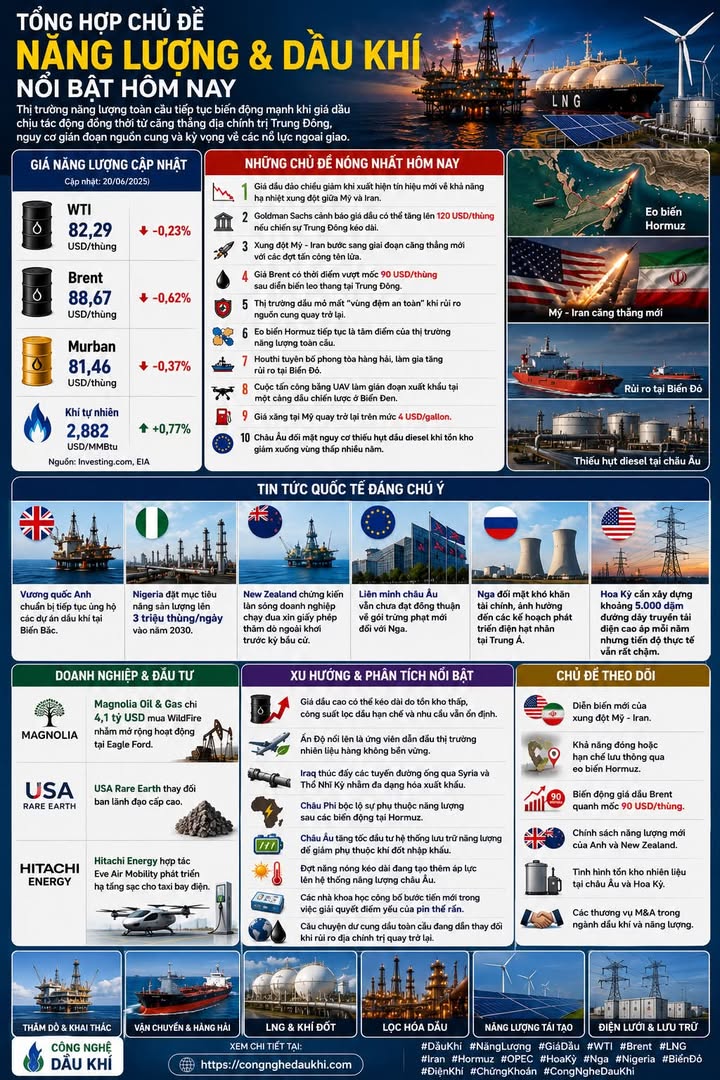
Is the market underestimating geopolitical risks in the Middle East, or is the current increase in oil prices just a short-term reaction to unstable fluctuations?
World oil prices have increased continuously for more than a week as the security situation in the Middle East continues to become complicated. According to data from ICE Futures Europe, CME Group and analysis from Reuters and Bloomberg, this development not only comes from the futures market but is also reinforced by signals of scarcity in the physical oil market.
It is worth noting that many previous forecasts of organizations such as the International Energy Agency and the US Energy Information Administration EIA said that oil supply in the second half of the year could improve thanks to increased output from OPEC +, the United States, Brazil, Guyana and Canada. However, these scenarios are all based on the assumption of a stable geopolitical environment. As tensions in the Middle East increased, markets quickly adjusted expectations.
Strait of Hormuz continues to be an area closely watched by investors. According to the U.S. Energy Information Administration EIA, about 20 percent of global oil consumption is transported through this strategic waterway. As soon as there is a risk of disruption, transportation costs, marine insurance fees and oil prices can all increase sharply in a very short time.
One signal that is of particular interest to analysts is that the physical oil market is stronger than expected. When spot oil prices rise faster than futures contracts, this phenomenon often reflects increased demand for actual delivery and short-term supply becoming more limited, rather than just fluctuations due to speculative activities in financial markets.
Comparison table between forecast and actual developments
Content Previous forecast Current developments
Strait of Hormuz Operation Stable, Risks Reduced The risk of disruption still exists
Oil prices May decrease due to oversupply Continue to increase for more than a week
Abundant physical oil supply Signals scarcity
Market sentiment Optimistic Cautious and defensive
Factors are supporting oil prices
Factor Influence level
Middle East tensions Very high
Risk of disruption to the Strait of Hormuz Very high
Physical oil supply is scarce High
Cargo insurance costs hModerate to high increase
Expectation of consumption demand recovery Moderate
In the current context, the oil market is simultaneously affected by geopolitical factors and actual supply and demand factors. If the Middle East situation continues to be tense or there are additional incidents affecting shipping activities through the Strait of Hormuz, oil prices may continue to fluctuate strongly.
On the contrary, if the security situation improves and supply from non-OPEC+ countries increases as forecast by the IEA and EIA, the pressure on price increases may ease in the following months. However, up to now, signals from the physical oil market show that supply risk factors are still more dominant than previous expectations of oversupply.
#Oil Price #Crude Oil #Brent #WTI #Hormuz #Iran #Middle East #OPEC #IEA #EIA #Energy #OilGas #Economy #OilMarket #TimKiemTop