Kudankulam Nuclear Power Plant Data Breach: Nearly 19,000 Sensitive Documents Leaked on Dark Web
In an alarming revelation that has sent shockwaves through cybersecurity circles, approximately 19,000 sensitive documents related to India's Kudankulam Nuclear Power Plant have been discovered circulating on the dark web. The breach has raised serious questions about the security of critical infrastructure and the vulnerabilities inherent in modern digital ecosystems.
Background: The Kudankulam Nuclear Power Complex
The Kudankulam Nuclear Power Plant, located in the Tirunelveli district of Tamil Nadu, India, represents one of the country's most significant energy infrastructure projects. Units 3 and 4, currently under construction, will add a combined capacity of 2,400 MW to India's nuclear energy portfolio. These units represent an investment of approximately $4 billion and are scheduled to commence operations by 2027, marking a crucial step in India's pursuit of clean energy security.
The facility, a collaboration between India and Russia, utilizes advanced VVER-1200 reactor technology, considered among the safest in the world. The breach, however, suggests that even the most modern nuclear facilities face significant cybersecurity challenges in an increasingly interconnected digital environment.
The Breach: Discovery and Timeline
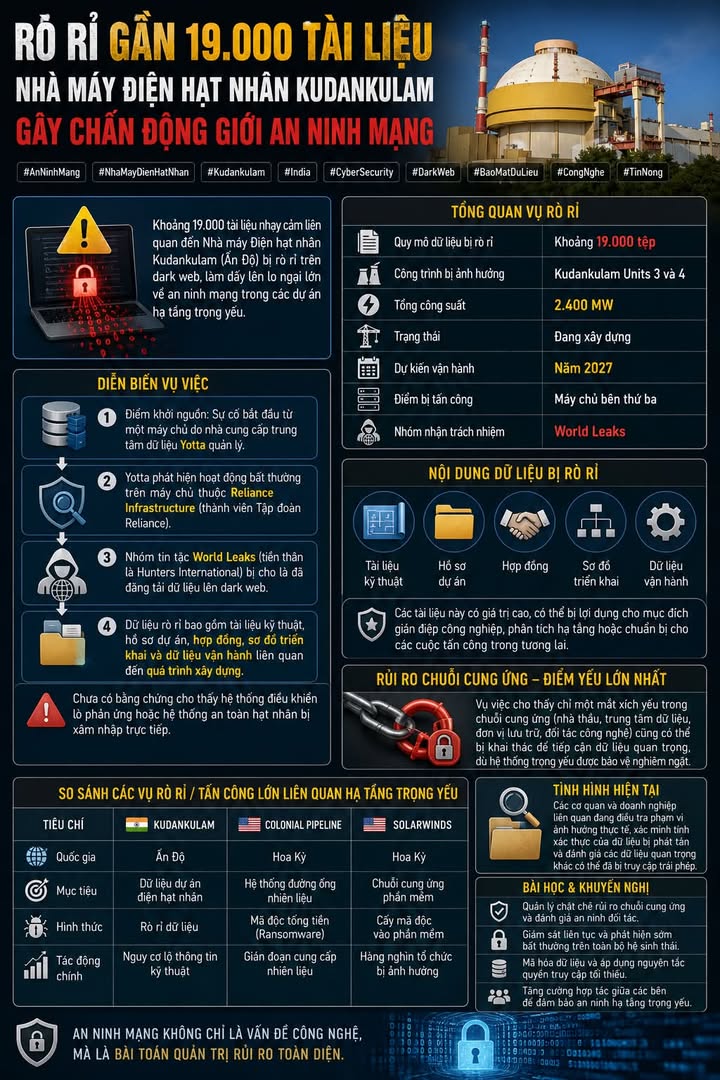
According to cybersecurity researchers, the breach was not directly targeting the plant's operational systems but originated from a third-party server. The compromised server was managed by Yotta, a data center provider that hosts infrastructure for Reliance Infrastructure, a subsidiary of India's Reliance Group.
The discovery began when Yotta detected unusual activity on one of its servers associated with Reliance Infrastructure. Following initial investigation, it became apparent that a significant amount of data had been exfiltrated. The compromised data subsequently surfaced on the dark web, where it was made available by the hacker group World Leaks—previously known as Hunters International.
Key Details of the Breach
| Category | Details |
|---|---|
| Scale of Data Breach | Approximately 19,000 files |
| Affected Facility | Kudankulam Units 3 and 4 |
| Total Capacity | 2,400 MW |
| Status | Under construction |
| Expected Operation | 2027 |
| Attack Vector | Third-party server |
| Responsible Group | World Leaks (formerly Hunters International) |
Nature of the Compromised Information
The leaked documents, according to cybersecurity analysts who have reviewed them, contain highly valuable technical information. While there is no public evidence suggesting direct penetration of the reactor control systems or nuclear safety mechanisms, the data includes:
- Detailed technical specifications and engineering drawings
- Project documentation and contractual agreements
- Deployment diagrams and system architecture
- Operational data related to the construction phase
- Security protocols and procedural documentation
What makes this breach particularly concerning is that the leaked information, while not directly controlling the reactors, could provide valuable insights for potential attackers planning future operations. The comprehensive nature of the documentation could facilitate sophisticated reconnaissance efforts or inform the development of tailored attack vectors.
Broader Implications for Critical Infrastructure Security
The Kudankulam breach serves as a stark reminder of the evolving threat landscape for critical infrastructure. It highlights several key concerns:
Supply Chain Vulnerabilities
Perhaps the most significant revelation from this incident is the critical role of third-party vendors in cybersecurity risk management. Even when primary systems are protected with state-of-the-art security measures, the ecosystem of contractors, data centers, technology providers, and storage solutions can create exploitable pathways.
"This breach demonstrates that modern cybersecurity cannot be siloed," noted Dr. Arjun Sharma, a cybersecurity expert specializing in critical infrastructure protection. "Organizations must extend their security perimeter to encompass their entire supply chain. A single compromised third-party server can provide access to volumes of sensitive data that could be used to plan future attacks."
The Growing Threat of Dark Web Data Markets
The appearance of this data on the dark web underscores the increasingly organized nature of cybercriminal operations. Marketplaces on the dark web facilitate the trading of stolen data, with specialized brokers often categorizing and valuing information based on its potential use in future attacks.
For nuclear facilities, the implications are particularly severe. The combination of technical specifications, security protocols, and operational data could be used by nation-state actors or terrorist groups to plan physical or cyber attacks, potentially with catastrophic consequences.
Comparative Analysis: Major Cybersecurity Incidents
The Kudankulam breach can be contextualized alongside other major cybersecurity incidents that have affected critical infrastructure:
| Incident | Kudankulam | Colonial Pipeline | SolarWinds |
|---|---|---|---|
| Country | India | United States | United States |
| Target | Nuclear power project data | Fuel pipeline systems | Software supply chain |
| Attack Method | Third-party server breach | Ransomware | Software supply chain compromise |
| Primary Impact | Information disclosure | Operational disruption | Massive data breach |
| Attribution | Uncertain (World Leaks) | DarkSide ransomware group | APT29 (suspected) |
| Long-term Implications | Reputational damage, potential future targeting | Increased fuel prices, supply chain disruption | Thousands of organizations affected, erosion of trust |
Lessons from Other Incidents
The Colonial Pipeline attack demonstrated how ransomware could cripple critical infrastructure, leading to fuel shortages and price increases across the eastern United States. Similarly, the SolarWinds breach revealed how sophisticated actors could compromise software supply chains to access thousands of organizations through a single vulnerability.
The Kudankulam incident, while not yet resulting in operational disruption, highlights a different but equally concerning threat vector: the systematic collection of sensitive technical data that could enable future attacks. This "data gathering" approach allows attackers to understand target systems thoroughly before launching potentially disruptive operations.
Current Status and Future Implications
As of the latest reports, Indian authorities and the organizations involved—including the Nuclear Power Corporation of India Limited (NPCIL), Yotta, and Reliance Infrastructure—are conducting a comprehensive assessment of the breach's impact. Key priorities include:
- Verifying the authenticity and scope of the leaked documents
- Determining whether any additional data beyond what appears on the dark web was accessed
- Assessing potential vulnerabilities that might have been introduced to operational systems
- Implementing enhanced security measures across the entire supply chain
The incident has already prompted calls for stricter regulations governing cybersecurity for critical infrastructure in India. The government is expected to review existing frameworks and potentially introduce more rigorous requirements for third-party vendors serving sensitive sectors.
For the nuclear industry globally, this breach serves as a wake-up call about the importance of extending security considerations beyond operational systems to encompass the entire ecosystem of partners, vendors, and service providers. The nuclear sector, with its uniquely high stakes, must adopt a "zero trust" approach that assumes potential compromise at every point in the supply chain.
Conclusion: The Imperative of Holistic Cybersecurity
The Kudankulam nuclear power plant data breach represents a significant warning about the evolving nature of cyber threats to critical infrastructure. It demonstrates that no organization, regardless of its security investments, can be complacent about third-party risks in an increasingly interconnected digital ecosystem.
"This incident underscores that cybersecurity is no longer just a technical challenge but a strategic imperative that requires organizational commitment at the highest levels," stated Dr. Priya Mehta, a cybersecurity policy expert. "For critical infrastructure operators, this means implementing comprehensive supply chain security programs, continuous monitoring of all third-party relationships, and assuming that adversaries will attempt to exploit these relationships."
As nuclear power continues to play a role in global energy transitions, ensuring the cybersecurity of these facilities becomes increasingly important. The Kudankulam breach, while concerning, offers an opportunity to strengthen security practices and develop more resilient approaches to protecting critical infrastructure in the digital age.