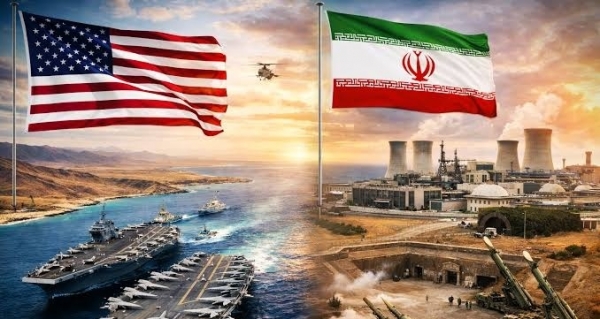
Iran Retaliates Against US as Middle East Escalates into New Cycle of Tensions
In an escalating geopolitical crisis in the Middle East, Iran has officially launched a military campaign described as "reciprocal" targeting US military facilities in the Gulf region. This development comes shortly after Washington conducted airstrikes against Iranian military targets over the weekend, pushing the region into a dangerous new spiral of hostilities.
Escalating Tensions: The Current Crisis
According to sources from Iran's Ministry of Defense, this retaliatory attack is a direct consequence of US airstrikes targeting facilities belonging to the Islamic Revolutionary Guard Corps (IRGC) in Iraq and Syria. The American strikes are reported to have caused significant damage to Iranian military infrastructure.
"We will not remain passive in the face of American provocations," a spokesperson for Iran's Ministry of Defense stated, while asserting that "any attack on Iranian territory will face deserved punishment."
Details of the Retaliatory Campaign
Military sources indicate that Iran's retaliation focused on US military bases across the Persian Gulf, including installations in Iraq, Kuwait, and other Gulf nations. The attacks were conducted using ballistic missiles and unmanned aerial vehicles, reportedly causing damage to several military facilities.
A US defense official confirmed that bases were attacked but declined to provide details about the extent of the damage. "We are assessing the situation and will respond appropriately," a Pentagon spokesperson stated.
International Community Response
The escalation of tensions between these two Middle Eastern powers has sparked significant concern within the international community. The United Nations has called for restraint from both parties, while European nations, particularly the UK, France, and Germany, have expressed deep concern about the risk of a larger conflict.
"We call on all parties to remain calm and avoid actions that could lead to uncontrollable conflict," a UN spokesperson said.
Situation Analysis
Tensions between Iran and the US have escalated in recent months following the US withdrawal from the 2015 Iran Nuclear Deal and the reimposition of economic sanctions. The US killing of Qasem Soleimani, commander of the IRGC's Quds Force, in January 2020 brought relations between the two countries to their lowest point since 1980.
Table 1: Timeline of Iran-US Tensions (2020-2023)
| Timeline | Event | Impact |
|---|---|---|
| January 2020 | US kills Soleimani | Iran responds with missile strikes on US base in Iraq |
| July 2020 | Iran mistakenly shoots down civilian aircraft | 176 deaths, international condemnation |
| April 2021 | US expands sanctions | Iran accelerates nuclear program |
| September 2022 | Protests erupt in Iran | US supports protesters, Iran accuses interference |
| March 2023 | US airstrikes on Iranian targets | Iran announces retaliatory campaign |
Economic and Energy Impacts
The escalating tensions in the Middle East have directly impacted global energy markets. Oil prices have surged following news of the attacks, with Brent crude rising more than 3% in today's trading session.
"Any conflict in the Gulf region could disrupt global oil supplies," an analyst from the World Bank noted. "Particularly concerning is that Iran is one of the world's largest oil producers."
Future Outlook
International analysts predict that tensions between Iran and the US may continue to escalate in the coming period. However, it's likely that both sides will attempt to limit the conflict to avoid a full-scale war.
"Both Iran and the US understand that a major conflict would cause severe damage to both parties," a political expert from the International Institute for Strategic Studies stated. "Therefore, we will likely see limited reciprocal attacks along with back-channel diplomatic efforts to de-escalate tensions."
However, the situation in the Middle East remains extremely fragile. Any unexpected incident could push the situation beyond control, with serious consequences for regional and global security.
Table 2: Possible Scenarios for the Middle East Situation
| Scenario | Probability | Consequences |
|---|---|---|
| Detente through diplomacy | 30% | Gradual normalization of relations, stable energy markets |
| Protracted limited conflict | 50% | Volatile energy markets, regional security instability |
| Full-scale conflict | 20% | Global energy crisis, widespread regional war |
Meanwhile, populations in regional countries, particularly Iraq and Afghanistan, are most concerned as they would directly face the consequences of any conflict between the two powers.
Humanitarian organizations have called on the international community to increase support for vulnerable countries in the Middle East, where the already complex humanitarian situation could worsen due to escalating conflict.
The confrontation between Iran and the US represents not merely a diplomatic crisis but a manifestation of deeper geopolitical conflicts in the Middle East. The outcome of this confrontation will shape the future of the region for decades to come.