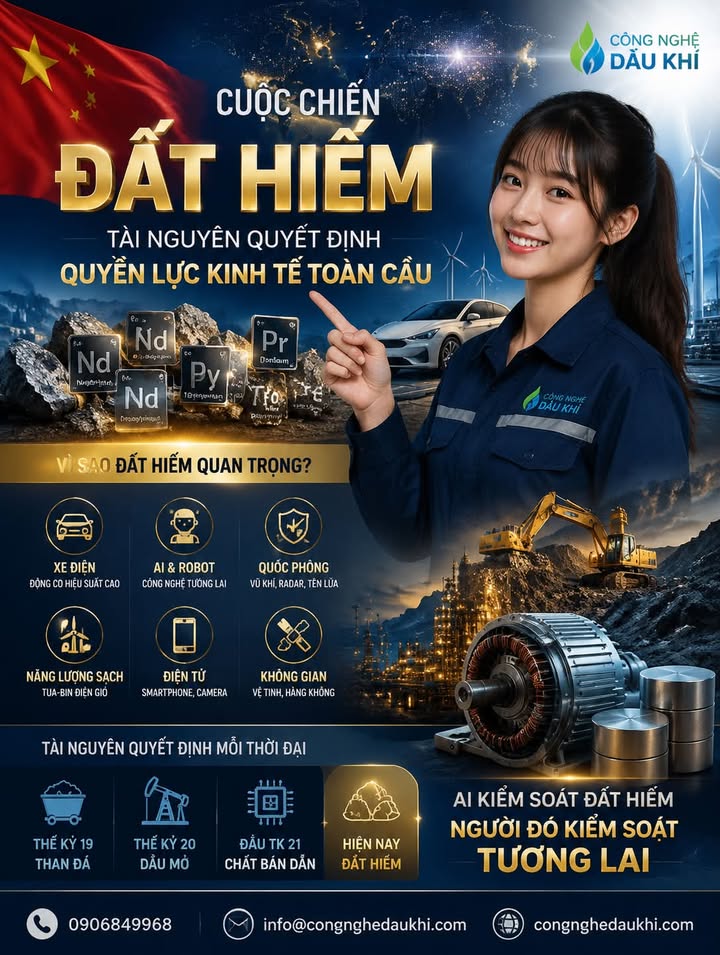
The Rare Earth War: How Strategic Resources Are Shaping Global Economic Power
What if one day China completely tightened its rare earth supply chain? Would companies like Apple, Tesla, NVIDIA, and Lockheed Martin—and indeed the entire global AI industry—be paralyzed within months?
As of July 11, 2026, competition among world powers no longer revolves solely around oil, natural gas, or semiconductors. Rare earth elements have emerged as a new "economic weapon," determining who will lead in artificial intelligence, electric vehicles, robotics, defense, and the digital economy.
While the 19th century was the age of coal, and the 20th century belonged to oil, the 21st century is witnessing rare earth elements become one of the most strategic resources influencing the global balance of power.
Notably, rare earth elements are not truly scarce in terms of reserves. The challenge lies in the technology of extraction, separation, refining, and permanent magnet production. This is the most valuable and difficult-to-replace link in the supply chain. According to new analysis from the International Energy Agency (IEA), China currently accounts for approximately 60% of global mining output, 91% of refining capacity, and about 94% of rare earth magnet production in 2024, creating a significant advantage across the entire value chain.
The Evolution of Strategic Resources Through History
| Period | Strategic Resource | Key Technologies/Industries |
|---|---|---|
| 19th Century | Coal | Industrial Revolution, railways, metallurgy |
| 20th Century | Oil | Automobiles, aviation, petrochemicals, military |
| Early 21st Century | Semiconductors | Smartphones, internet, cloud computing, AI |
| 2025-2035 | Rare Earth Elements | Electric vehicles, robotics, AI, defense, clean energy |
Why Rare Earth Elements Matter
Unlike oil, which can be partially replaced by renewable energy or natural gas, many rare earth elements currently have no substitute materials with comparable performance in high-tech applications.
| Industry | Role of Rare Earth Elements |
|---|---|
| Electric Vehicles | High-performance magnets in motors (Tesla, BYD, Hyundai) |
| AI | Servers, robotics, data centers |
| Defense | Radar systems, F-35 fighters, missiles, submarines |
| Wind Energy | High-capacity power generators |
| Smartphones | Cameras, speakers, vibration, sensors |
| Aerospace | Satellites, aircraft engines |
China vs. America: What's Being Competed For?
| Capability | China | United States |
|---|---|---|
| Mining | Dominant position | Expanding operations |
| Refining | Absolute dominance | Heavy investment |
| Rare Earth Magnets | Near-total control | Building new supply chains |
| Supply Chain | Complete | Reducing dependence |
Meanwhile, the European Union, Japan, Australia, South Korea, and Canada are investing tens of billions of dollars to build independent supply chains and reduce dependence on China. New projects focus on domestic mining, refining, recycling, and magnet production.
The War Is No Longer About Mining
Many people believe that the country with the most mines will win this competition.
The reality is exactly the opposite.
The greatest value lies in the technology for refining rare earth elements and producing materials from them. This is why many countries with large reserves still have to export ore to other locations for processing.
According to the IEA, even if many new mines are brought into operation over the next decade, the refining and magnet production stages will remain the biggest "bottleneck" in the global supply chain.
What Would Happen If Supply Were Disrupted?
| Industry | Potential Impact |
|---|---|
| Electric Vehicles | Sharp increase in motor costs |
| AI | Server component shortages |
| Robotics | Reduced production output |
| Defense | Materials shortage for advanced weapons |
| Wind Energy | Project delays |
| Electronics | Higher prices for smartphones and devices |
The IEA warns that if comprehensive export control measures are implemented, the production value in countries outside China could face impacts of up to $6.5 trillion annually, with automotive, electronics, defense, and data centers being the most affected sectors.
Recent developments show the competition is heating up. On July 6, 2026, Reuters reported that many Japanese companies continued to warn about supply risks due to China's export control measures, while the United States continues to invest heavily in domestic mining and magnet production to reduce dependence.
The Future Outlook
Rare earth elements are repeating the story that oil once created in the previous century, but with an even broader impact. The nation that controls the entire value chain—from mining to refining and material production—will hold the advantage in AI, electric vehicles, defense, robotics, and many core technology sectors for decades to come.
This competition is not merely a race to extract resources but a contest over technology, production capabilities, supply chains, and control of the global digital economy.
As the world becomes increasingly dependent on rare earth elements for technological advancement, the nations that secure their supply chains will not only ensure their economic prosperity but also their geopolitical influence in the decades ahead.