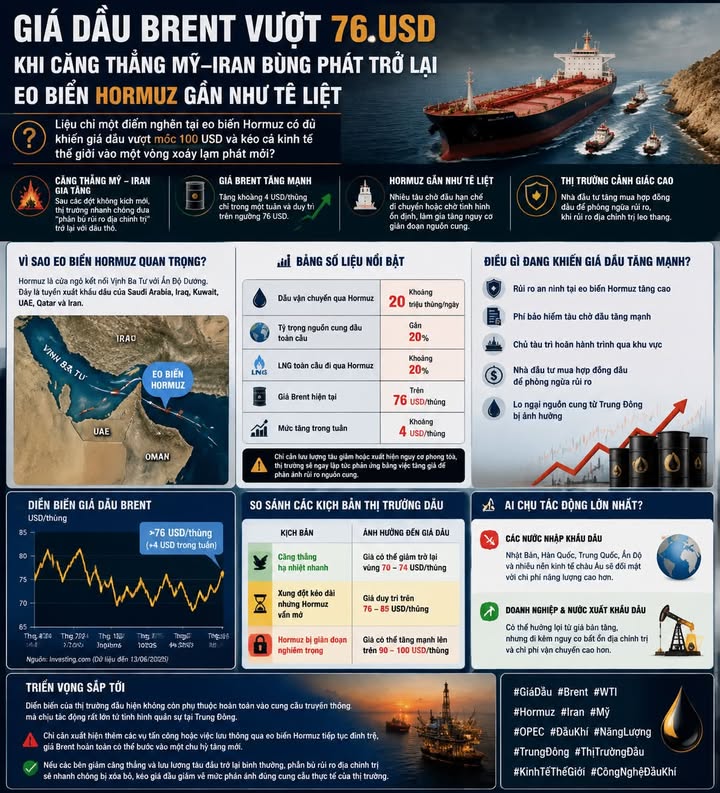
Will just one blockage in the Strait of Hormuz be enough to cause oil prices to surpass the $100 mark and drag the world economy into a new inflationary spiral?
Military tensions between the US and Iran have once again put the global energy market on high alert. After the new airstrikes, the market quickly brought back the “geopolitical risk premium” for crude oil, helping Brent prices increase by about 4 USD per barrel in just a week and maintain above the threshold of 76 USD.
The biggest reason is not the amount of oil lost immediately, but the risk of supply disruption. Shipping through the Strait of Hormuz, the world's most important shipping lane for oil, is said to have slowed significantly as many tankers temporarily limit their movements or wait for the situation to stabilize.
Why is the Strait of Hormuz important?
Hormuz is the gateway connecting the Persian Gulf to the Indian Ocean. This is the oil export route of Saudi Arabia, Iraq, Kuwait, UAE, Qatar and Iran.
Outstanding data table
Indicator Estimated value
Oil shipped via HormuzAbout 20 million barrels per day
The proportion of global oil supply is nearly 20 percent
About 20 percent of global LNG passes through Hormuz
Current Brent price Above 76 USD per barrel
Increase for the week About 4 USD per barrel
As long as ship traffic decreases or there is a risk of blockade, the market will immediately react by increasing prices to reflect supply risks.
What is causing oil prices to increase sharply?
Not only the attacks between the US and Iran, the market is also concerned about the possibility of a prolonged conflict causing shipping disruptions for weeks.
Factors supporting oil prices include:
* Security risks in the Strait of Hormuz have increased
* Tanker insurance premiums increased sharply
* Ship owners delay journeys through the area
* Investors buy oil contracts to prevent risks
* Concerned that supply from the Middle East will be affected
Compare oil market scenarios
Scenario Impact on oil prices
Tensions cool down quickly Prices could fall back to the range of 70 to 74 USD per barrel
Conflict drags on but Hormuz remains open Prices remain above 76 to 85 USD per barrel
Severe disruption of Hormuz Prices could rise sharply above $90 to $100 per barrel
Who is most affected?
Oil importing countries such as Japan and South Korea, China, India and many European economies will face higher energy costs if the situation continues to escalate.
Meanwhile, oil and gas exploitation enterprises and oil exporting countries can benefit from increased selling prices, but this benefit also comes with the risk of geopolitical instability and higher transportation costs.
Upcoming prospects
The evolution of the oil market is no longer completely dependent on traditional supply and demand but is greatly influenced by the military situation in the Middle East. As long as more attacks appear or traffic through the Strait of Hormuz continues to stagnate, Brent prices could completely enter a new increasing cycle.
On the contrary, if the parties reduce tensions and oil tanker traffic returns to normal, the geopolitical risk premium will quickly be eliminated, pulling oil prices down to a level that accurately reflects the market's actual supply and demand.
#OilPrice #Brent #WTI #Hormuz #Iran #US #OPEC #OilGas #Energy #MiddleEast #OilMarket #WorldEconomy #OilTechnology