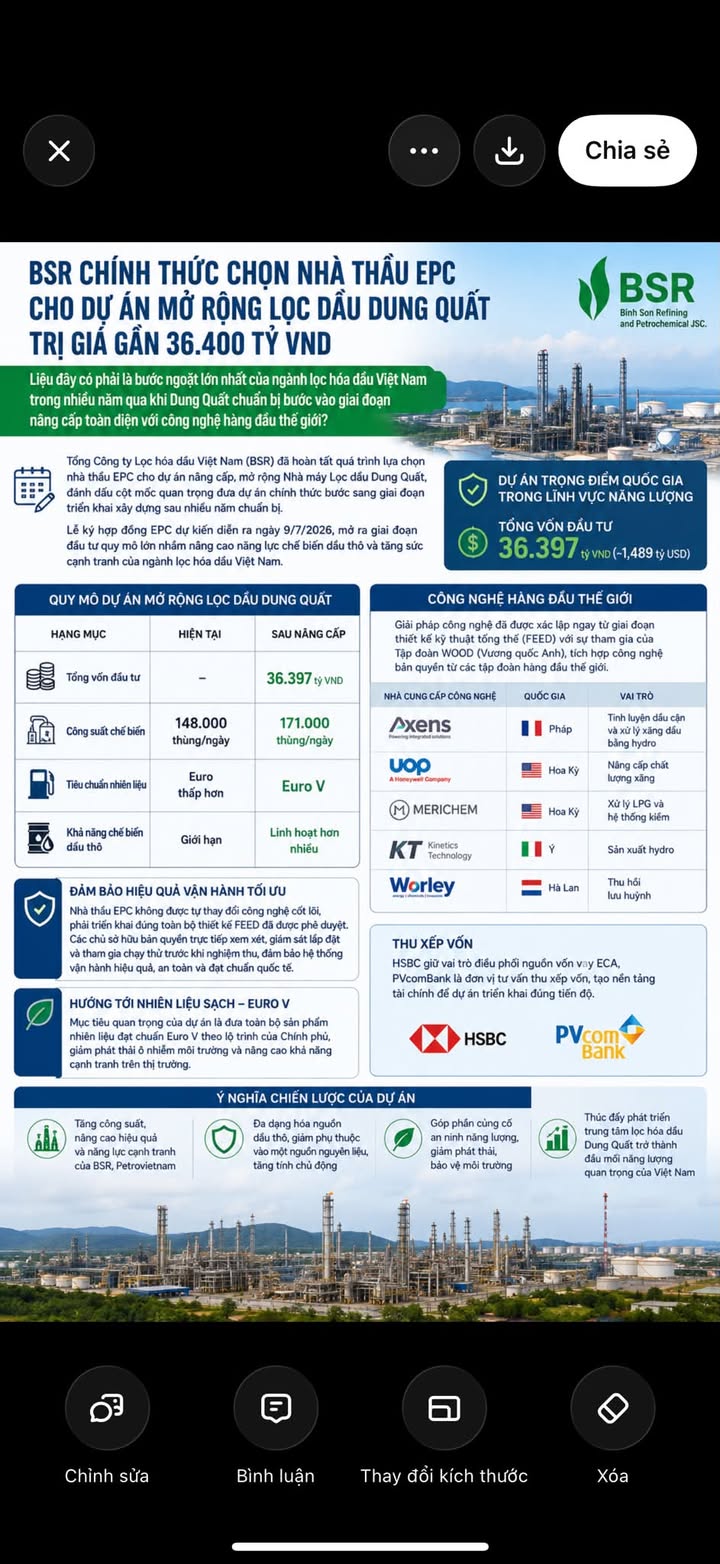
BSR Selects EPC Contractor for Dung Quat Refinery Expansion: Transforming Vietnam's Energy Landscape
In a landmark development for Vietnam's energy sector, the Vietnam Oil and Gas Group (BSR) has officially selected an Engineering, Procurement, and Construction (EPC) contractor for the expansion project of the Dung Quat Oil Refinery. This significant move marks a pivotal moment in the nation's industrial development, with total investment reaching approximately 36,397 billion VND (equivalent to 1.489 billion USD). The project represents the most substantial upgrade to Vietnam's refining capabilities in recent years and is positioned to elevate the country's position in the regional energy market.
Project Overview: A National Priority
The Dung Quat Oil Refinery expansion has been officially designated as a key national project in Vietnam's energy sector. The project is scheduled to reach a critical milestone with the EPC contract signing ceremony planned for July 9, 2026, officially transitioning the initiative from preparation to implementation phase.
When completed, the refinery's processing capacity will increase from 148,000 barrels of crude oil per day to 171,000 barrels per day. This expansion not only enhances production volume but also significantly improves the refinery's flexibility in processing various types of crude oil, both domestic and imported.
Technical Specifications and Upgrades
The expansion project introduces comprehensive technological upgrades that will position the Dung Quat refinery among the most advanced facilities in the region. The most significant improvement is the transition to producing fuels meeting Euro V standards, representing a substantial leap in environmental performance and product quality.
| Dung Quat Oil Refinery: Current vs. Post-Expansion | ||
|---|---|---|
| Parameter | Current Status | After Expansion |
| Total Investment | - | 36,397 billion VND |
| Processing Capacity | 148,000 barrels/day | 171,000 barrels/day |
| Fuel Standards | Euro standards (below Euro V) | Euro V |
| Crude Oil Flexibility | Limited range | Significantly expanded capability |
Advanced Technology Integration
A distinguishing feature of the Dung Quat expansion project is the comprehensive technology solution established during the Front-End Engineering Design (FEED) phase, developed with the British engineering firm WOOD Group. This approach ensures that the refinery incorporates cutting-edge technologies from leading global providers.
The technology integration process involves direct collaboration with several international technology licensors, each contributing specialized expertise to different aspects of the refinery's operations. This collaborative approach guarantees that the facility will operate at peak efficiency while maintaining the highest standards of safety and environmental compliance.
Technology Partners and Their Contributions
| Technology Provider | Country | Primary Contribution |
|---|---|---|
| Axens | France | Residue upgrading and hydrotreating of gasoline and diesel |
| UOP | USA | Gasoline quality improvement |
| Merichem | USA | LPG treatment and caustic system |
| KT Kinetics Technology | Italy | Hydrogen production |
| Worley Netherland | Netherlands | Sulfur recovery |
Implementation Approach: Rigorous Technical Standards
Unlike traditional EPC projects where contractors may have flexibility in technology selection, the Dung Quat expansion project implements a more structured approach. The selected EPC contractor must strictly adhere to the complete FEED design without modifications to core technologies. This design discipline ensures operational consistency and performance optimization.
The implementation process includes direct oversight from technology licensors at every critical stage. These licensors will review detailed designs, supervise installation, and participate in commissioning and testing processes before final acceptance. This rigorous quality control mechanism minimizes technical risks and ensures the facility achieves optimal operational efficiency and product quality meeting international standards.
Environmental and Market Benefits
A primary objective of the expansion project is to upgrade all fuel products to meet Euro V emission standards in alignment with Vietnam's environmental roadmap. This transition will significantly reduce harmful emissions, contributing to improved air quality and public health outcomes.
The Euro V compliant fuels will enhance the competitiveness of Dung Quat's products in both domestic and international markets. As global environmental regulations continue to tighten, positioning the refinery at the forefront of clean fuel production provides a strategic advantage in an increasingly sustainability-conscious marketplace.
Financing Structure
The expansion project is supported by a robust financing framework designed to ensure timely implementation. HSBC has been appointed as the coordinator for Export Credit Agency (ECA) financing, while PVcomBank serves as the financial arranging advisor. This financing structure provides the necessary capital foundation while maintaining financial discipline throughout the project lifecycle.
Strategic Importance for Vietnam's Energy Security
The Dung Quat refinery expansion represents more than a simple capacity increase—it fundamentally enhances Vietnam's energy security and industrial capabilities. The expanded facility will demonstrate greater adaptability to global crude oil supply fluctuations, with the ability to process a more diverse range of crude oil types. This flexibility reduces dependency on single sources of raw materials and increases the nation's energy independence.
When completed, the project will strengthen national energy security, enhance operational efficiency of BSR and Petrovietnam, and accelerate the development of Dung Quat as a central energy hub in Vietnam's economic landscape. The facility is positioned to become one of the most critical energy infrastructure assets in the country, supporting industrial growth and economic development for decades to come.
The successful implementation of this project will mark a significant milestone in Vietnam's industrialization journey, demonstrating the country's capability to execute large-scale, technologically advanced energy projects that meet international standards while contributing to sustainable development goals.