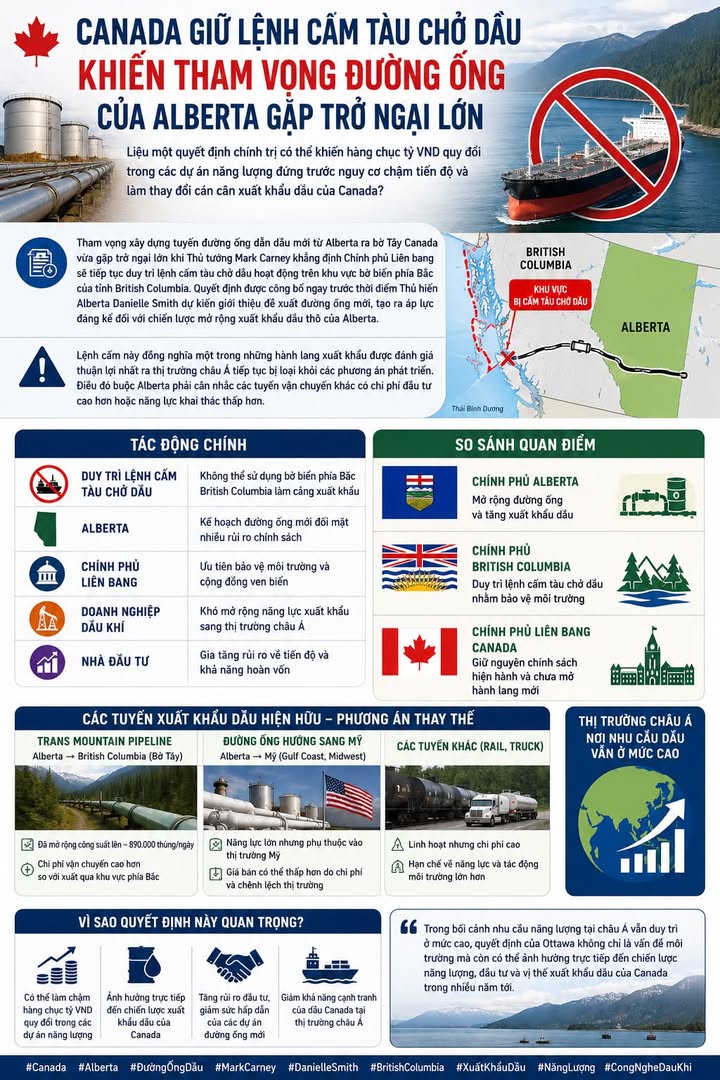
Canada's Oil Tanker Ban Creates Major Obstacle for Alberta's Pipeline Ambitions
Can a political decision potentially jeopardize multi-billion dollar energy projects and alter Canada's oil export balance? The ambitious plan to construct a new oil pipeline from Alberta to Canada's west coast has encountered a significant setback as Prime Minister Mark Carney affirmed that the federal government will maintain its ban on oil tankers operating along the northern coast of British Columbia.
This announcement, made just prior to Alberta Premier Danielle Smith's expected unveiling of a new pipeline proposal, has placed considerable pressure on the province's strategy to expand oil exports. The tanker ban effectively removes one of the most advantageous export corridors to Asia from consideration, compelling Alberta to evaluate alternative transportation routes that either require higher investment or offer lower capacity.
The Federal Decision and Its Immediate Consequences
Prime Minister Carney's stance represents a continuation of environmental protection policies that have long been a point of contention between federal authorities and resource-rich provinces. The ban specifically targets the northern coastal waters of British Columbia, an area that would have been crucial for any new pipeline aiming to connect Alberta's oil sands with Pacific markets.
The timing of this announcement is particularly noteworthy, occurring just as Alberta was preparing to advance its energy export strategy. This political maneuver has immediate implications for the province's economic planning and may force a reassessment of long-term energy infrastructure investments.
| Key Impact Areas | Consequences |
|---|---|
| Export Infrastructure | Eliminates northern British Columbia coastline as potential export terminal location |
| Alberta's Energy Strategy | New pipeline plans face significant policy obstacles |
| Federal Priorities | Continued emphasis on environmental protection and coastal community safety |
| Oil Industry Expansion | Increased difficulty in expanding export capacity to Asian markets |
| Investment Climate | Elevated risk regarding project timelines and return on investment |
Provincial Conflict: Economic Development vs. Environmental Protection
The current situation underscores the fundamental divide between Alberta and British Columbia regarding energy development. Alberta, home to the vast oil sands, seeks to maximize resource extraction and export opportunities, while British Columbia prioritizes preserving its coastal ecosystems and minimizing the risk of oil spills.
Alberta's government argues that expanded pipeline infrastructure is essential for economic growth and that technological advancements have significantly reduced environmental risks associated with oil transport. Conversely, British Columbia emphasizes the potential catastrophic impact of a major oil spill on its sensitive coastal environments, fisheries, and tourism industries.
| Stakeholder | Perspective | Primary Concerns |
|---|---|---|
| Alberta Government | Advocates for pipeline expansion to increase oil export capacity | Economic growth, job creation, maximizing resource value |
| British Columbia Government | Supports maintaining oil tanker ban | Environmental protection, coastal ecosystem preservation |
| Federal Government | Upholds current policy without new corridor development | Balancing economic interests with environmental commitments |
Alternative Export Routes and Their Limitations
With the northern British Columbia corridor effectively closed, Alberta faces significant challenges in finding viable alternatives for transporting oil to Asian markets. The existing options present various limitations:
- Trans Mountain Expansion: While this project is already underway, its capacity is limited and may not fully meet Alberta's export ambitions.
- US-Bound Pipelines: Routes southward to the United States offer greater capacity but access Asian markets less efficiently and often at lower prices.
- Eastern Routes: Pipelines to eastern Canada and potential export through Atlantic ports face similar environmental opposition and longer transportation distances to Asian markets.
- Rail Transport: While flexible, rail transport is significantly more expensive per barrel than pipelines and carries higher safety risks.
Each alternative presents a trade-off between cost, capacity, environmental impact, and market access. The absence of a direct Pacific route places Canadian oil at a competitive disadvantage compared to other global producers.
Strategic Implications for Canada's Energy Sector
The maintenance of the oil tanker ban extends beyond immediate project delays to affect Canada's long-term energy strategy and international competitiveness. With Asian energy demand remaining robust, Canada's ability to position itself as a reliable supplier to these markets is increasingly constrained.
Without expanded pipeline capacity to the Pacific, Canadian oil faces several competitive disadvantages:
- Higher transportation costs reduce price competitiveness against US, Saudi Arabian, and UAE oil.
- Limited access to premium Asian markets forces Canadian producers to accept lower prices from US refineries.
- Reduced bargaining power in international energy markets.
- Potentially slower growth in oil sands development due to transportation bottlenecks.
These factors collectively impact Canada's position in the global energy landscape and may influence future investment decisions in the oil sector.
Expert Analysis and Future Outlook
Industry analysts suggest that the federal government's decision reflects a prioritization of environmental protection over short-term economic gains in the oil sector. This approach aligns with Canada's international climate commitments but creates tension with provinces heavily dependent on resource revenues.
Premier Smith's expected pipeline proposal will need to address both economic imperatives and environmental concerns if it is to gain traction. Potential strategies might include:
- Incorporating advanced spill prevention and response technologies.
- Offering enhanced economic benefits to British Columbia communities.
- Phased implementation with strict environmental monitoring.
- Diversification into lower-carbon energy sources alongside traditional oil production.
The outcome of this policy debate will likely shape Canada's energy landscape for years to come, balancing economic development with environmental stewardship in an increasingly complex global energy market.
Conclusion
Prime Minister Carney's affirmation of the oil tanker ban represents more than a regulatory decision—it embodies the complex tension between economic development and environmental protection that defines Canada's energy discourse. As Alberta seeks to expand its oil export capabilities, the closure of the northern British Columbia corridor presents a significant challenge that will require innovative solutions and political compromise.
In the broader context, this situation highlights the evolving nature of energy policy in Canada, where traditional resource development must increasingly navigate environmental considerations and changing market dynamics. The resolution of this conflict will not only determine the fate of specific pipeline projects but will also shape Canada's role in the global energy sector for decades to come.