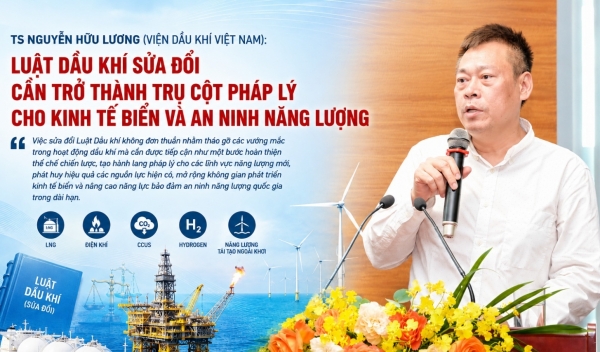
Amended Petroleum Law: Legal Pillar for Marine Economy and National Energy Security
In the context of Vietnam's growing maritime economy and the increasing need to strengthen national energy security, the amendment of the Petroleum Law has become both necessary and urgent. According to Dr. Nguyen Huu Luong, a senior expert at the Vietnam Petroleum Institute (VPI), revising the Petroleum Law not only aims to resolve existing obstacles in petroleum activities but should also be viewed as a crucial step in perfecting the strategic institutional framework.
Objectives of the Petroleum Law Amendment
The amendment of this law has several specific objectives:
- Creating a legal framework for new energy sectors
- Enhancing the effectiveness of existing resources in the petroleum industry
- Expanding the space for marine economic development
- Improving the capacity to ensure long-term national energy security
These objectives align with Vietnam's broader economic development strategy, which increasingly emphasizes the marine economy as a key growth driver. The petroleum sector, as a traditional pillar of Vietnam's energy landscape, requires updated legal foundations to remain competitive and relevant in the evolving global energy context.
The Importance of Marine Economy and Energy Security
The marine economy is playing an increasingly vital role in Vietnam's overall economic development. With its extensive coastline and abundant marine resources, Vietnam possesses significant potential to develop marine-related industries, with the petroleum sector being particularly crucial. Energy security remains a critical factor that directly impacts economic, political, and national security.
| Vietnam's Marine Economy Potential | |
|---|---|
| Coastline Length | 3,260 kilometers |
| Exclusive Economic Zone | Approximately 1 million km² |
| Continental Shelf Area | Over 400,000 km² |
| Oil and Gas Reserves | Estimated 500 million tons of oil equivalent |
The intersection of marine economic development and energy security creates a complex landscape that requires sophisticated legal frameworks to navigate effectively. Vietnam's geographic position in the South China Sea further complicates this equation, as it involves both significant opportunities and sensitive geopolitical considerations.
Current Challenges in the Petroleum Sector
Currently, Vietnam's petroleum industry faces numerous challenges, including:
- Lack of clear legal frameworks for petroleum activities
- Increasing competition from renewable energy sources
- Pressure from international commitments regarding environmental protection and sustainable development
- Technological limitations in extraction and processing
- Declining production from mature fields
- Geopolitical complexities in the South China Sea
These challenges are not unique to Vietnam but are particularly acute due to the country's specific geographic, economic, and political context. The global energy transition toward renewable sources presents both threats and opportunities for Vietnam's petroleum sector, making legal adaptation essential for future viability.
Proposals for the Amended Petroleum Law
To address current and future requirements, Dr. Nguyen Huu Luong has proposed several key amendments to the Petroleum Law:
- Specific regulations on petroleum resource management and development
- Incentives for investment in new technologies and renewable energy
- Strengthened international cooperation in the petroleum sector
- Enhanced environmental protection measures
- Clearer dispute resolution mechanisms
- Modernized licensing procedures to attract investment
Strategic Implications of the Amendment
The amendment of the Petroleum Law carries significant strategic implications for Vietnam's economic development and energy security. A modernized legal framework would:
- Attract foreign direct investment in Vietnam's petroleum sector
- Facilitate technology transfer and knowledge sharing
- Enhance environmental sustainability in petroleum operations
- Strengthen Vietnam's position in regional energy cooperation
- Provide a stable foundation for long-term energy planning
| Key Areas of Legal Reform | Expected Benefits |
|---|---|
| Licensing and Investment | Increased transparency, reduced bureaucracy, improved investor confidence |
| Environmental Regulations | Enhanced sustainability compliance, reduced ecological impact, improved public acceptance |
| Technology Transfer | Modernized extraction techniques, improved efficiency, reduced carbon footprint |
| International Cooperation | Enhanced regional stability, shared resources, joint development opportunities |
Implementation Considerations
Successfully implementing the amended Petroleum Law requires careful consideration of several factors:
- Balance between economic development and environmental protection
- Harmonization with existing legal frameworks
- Capacity building for regulatory agencies
- Stakeholder engagement and public consultation
- Phased implementation to allow for adjustment
Conclusion
The amendment of the Petroleum Law represents a strategic necessity for developing Vietnam's marine economy and ensuring national energy security. To achieve this, consensus and determination from government agencies, enterprises, and community participation are required to build a complete, flexible, and effective legal system.
The amended Petroleum Law will not only benefit the petroleum industry but also contribute significantly to the sustainable development of the national economy in the context of international integration. As Vietnam navigates the complex global energy transition, a modernized legal framework will be essential to balancing traditional petroleum development with emerging renewable energy sources.
The future of Vietnam's energy security and marine economy depends on creating a legal environment that can adapt to changing global conditions while maximizing the country's unique geographic and resource advantages.