India Sets Record for Russian Crude Oil Imports in June
Sanctions Backfire as Russia's Oil Exports to India Surge to Record Levels
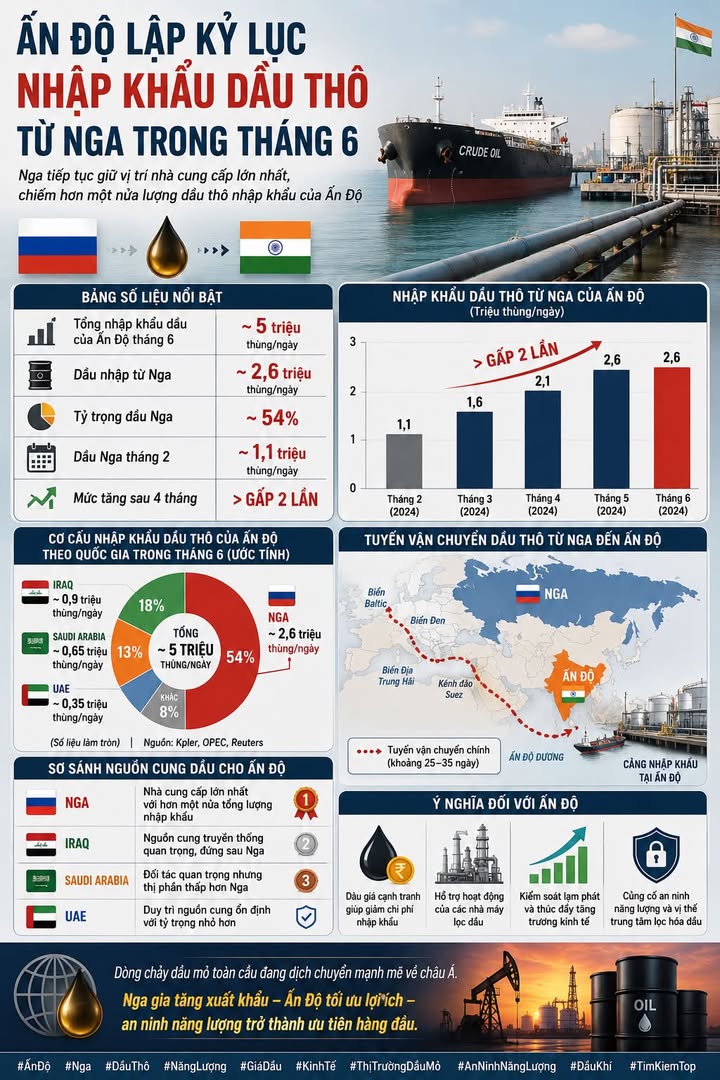
The global energy market has recently witnessed a significant milestone as India's crude oil imports in June reached approximately 5 million barrels per day, marking the highest level ever recorded for the month of June. What makes this development particularly noteworthy is that Russia has maintained its position as the largest supplier, providing about 2.6 million barrels per day, which accounts for approximately 54 percent of India's total crude oil imports.
This figure represents the highest volume in the history of oil and gas trade relations between Russia and India. Just a few months earlier, in February, Russia's oil exports to India stood at only about 1.1 million barrels per day, primarily due to pressure from Western sanctions and tightened transportation measures by the United States and other Western nations. However, within just four months, this volume has more than doubled.
Record Trade Volume Between Russia and India
| Indicator | Value |
|---|---|
| Total Indian oil imports (June) | Approximately 5 million barrels per day |
| Russian oil imports | Approximately 2.6 million barrels per day |
| Russian oil percentage | Approximately 54 percent |
| Russian oil (February) | Approximately 1.1 million barrels per day |
| Four-month increase | More than double |
Strategic Importance for India's Energy Security
Russia continues to demonstrate its crucial role in India's energy security strategy, thanks to its ability to supply large volumes at competitive prices. Against the backdrop of India's continuously increasing fuel consumption demand, maintaining a stable supply source holds particular significance for the world's fastest-growing major economy.
Comparison of Oil Suppliers to India
| Country | Current Role |
|---|---|
| Russia | Largest supplier, accounting for more than half of total imports |
| Iraq | One of traditional suppliers but behind Russia |
| Saudi Arabia | Continues to be an important partner but with smaller market share than Russia |
| UAE | Maintains stable supply with smaller share |
Global Oil Trade Realignment
The significant increase in Russian exports to India indicates a substantial shift in global oil trade flows since the onset of geopolitical conflicts and sanctions. Instead of relying on the European market as it did previously, Russia has shifted its focus to major customers in Asia, with India and China playing central roles.
For India, this strategy of diversifying supply sources and leveraging discounted oil prices helps reduce import costs, supports refinery operations, and contributes to controlling domestic inflation. Simultaneously, the country is strengthening its position as one of the world's largest centers for oil refining and fuel exports.
Future Implications for Global Energy Markets
If this trend continues in the coming months, the global oil trade balance could shift further toward Asia, while Russia increasingly reduces its dependence on traditional European markets. This also demonstrates that energy security is becoming a more important factor than geopolitical pressures in many countries' decisions to purchase oil.
The development raises questions about the effectiveness of Western sanctions against Russia, as they appear to have inadvertently facilitated stronger trade relationships between Russia and major Asian economies. The data suggests that market forces and economic pragmatism may be prevailing over political considerations in the global energy landscape.
Conclusion
The record-breaking oil trade between Russia and India represents a significant realignment in global energy markets. As traditional trade patterns evolve, both countries are strategically positioning themselves to benefit from this new configuration, with India securing its energy needs at favorable prices and Russia finding new markets amid sanctions.
This development underscores the complex interplay between energy security, economic interests, and geopolitical considerations in today's global economy. As the world's largest energy consumers continue to seek reliable and affordable supply sources, the global oil trade landscape will likely continue to transform in ways that challenge traditional assumptions about market dynamics and international relations.