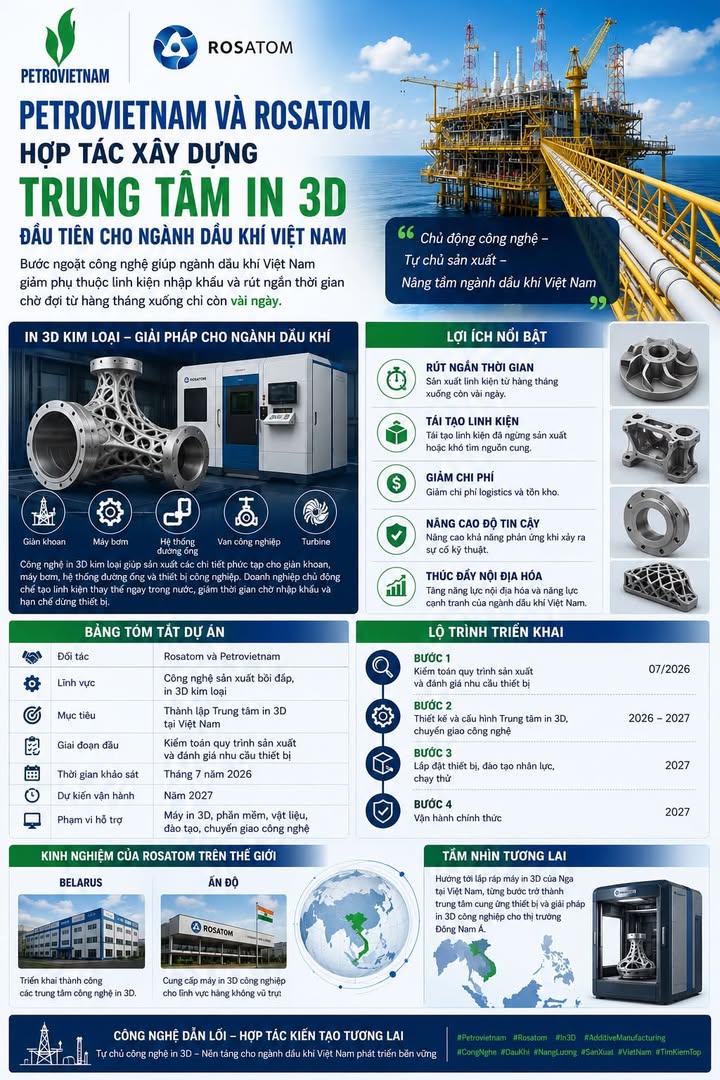
Strategic Partnership: Rosatom and Petrovietnam to Establish Vietnam's First 3D Printing Center for Oil and Gas Industry
In a move that could potentially transform Vietnam's industrial manufacturing capabilities, Rosatom and Petrovietnam have signed a Memorandum of Understanding to develop additive manufacturing technology in Vietnam, with the ambitious goal of establishing the country's first specialized 3D printing center for the oil and gas sector. This collaboration represents a significant technological leap that could reduce Vietnam's dependence on imported components and slash waiting times for critical parts from months to mere days of domestic production.
A Strategic Technological Alliance
The memorandum between Russia's state nuclear energy corporation and Vietnam's state-owned oil and gas giant marks a pivotal moment in the nation's industrial development. Unlike typical equipment supply agreements, this partnership encompasses a comprehensive technology transfer that includes not just hardware but the entire ecosystem of additive manufacturing—software, materials, workforce training, and technical support.
"This is more than just buying machines; it's about building indigenous manufacturing capabilities," commented industry analysts familiar with the agreement. "By partnering with Rosatom, Petrovietnam gains access to proven industrial 3D printing technologies that have been successfully implemented in other countries."
Comprehensive Technology Transfer Model
What distinguishes this collaboration is its holistic approach. Rosatom has committed to transferring complete technological know-how rather than merely supplying equipment. Russian experts will conduct thorough evaluations of Petrovietnam's existing production infrastructure before determining the optimal configuration for the new 3D printing center.
This assessment will inform critical decisions regarding the number and type of 3D printers required, suitable materials for oil and gas applications, and streamlined production processes tailored to Vietnam's specific industrial needs.
Revolutionizing Oil and Gas Equipment Manufacturing
The planned 3D printing center will focus on producing complex mechanical components essential to offshore and onshore oil and gas operations. These include specialized parts for drilling rigs, high-performance pumps, pipeline systems, and various other industrial equipment critical to energy production.
Traditional manufacturing methods often struggle with the intricate geometries required for modern oil and gas equipment. Additive manufacturing, however, excels at producing complex shapes with internal channels, optimized weight distributions, and integrated features that would be impossible or prohibitively expensive to manufacture using conventional techniques.
Addressing Critical Industry Challenges
One of the most pressing challenges in the oil and gas industry is the availability of replacement parts for aging infrastructure. Many offshore platforms and onshore facilities have been in operation for decades, and original equipment manufacturers often no longer produce certain components.
The 3D printing center will have the capability to regenerate these obsolete parts using digital archives or reverse engineering of existing components. This capability alone could save millions of dollars in equipment replacement costs and extend the operational lifespan of critical infrastructure.
Furthermore, the technology can produce large-sized components that are difficult to source internationally, reducing dependency on global supply chains that are increasingly vulnerable to geopolitical disruptions and logistical challenges.
Transforming Vietnam's Industrial Landscape
If implemented according to schedule, this initiative could fundamentally transform Vietnam's position in the regional industrial manufacturing ecosystem. The development of domestic high-tech manufacturing capabilities would reduce the country's reliance on imported components while building expertise in advanced manufacturing technologies.
"This represents a strategic opportunity for Vietnam to leapfrog traditional manufacturing stages and develop capabilities in Industry 4.0 technologies," explained Dr. Nguyen Van An, a manufacturing technology expert at Hanoi University of Science and Technology. "The oil and gas sector is an ideal starting point due to its high-value components and critical nature to the national economy."
Economic and Operational Benefits
The implementation of 3D printing technology for oil and gas applications offers multiple economic advantages:
- Reduced logistics costs by eliminating the need for international shipping of heavy components
- Decreased inventory costs through on-demand production rather than warehousing spare parts
- Extended equipment lifespan through the ability to produce replacement parts for obsolete systems
- Enhanced operational continuity by reducing downtime waiting for critical components
- Technology transfer benefits that can be applied to other industrial sectors
For offshore operations, where equipment failure can result in massive production losses and environmental risks, the ability to produce replacement parts domestically represents a significant improvement in operational resilience and response capability.
International Experience and Local Implementation
Rosatom brings extensive experience in implementing industrial 3D printing solutions across various sectors. The corporation has successfully established technology centers in Belarus and provided industrial 3D printing systems for the aerospace industry in India. These implementations have demonstrated the viability of transferring advanced manufacturing capabilities to partner nations.
"Our experience in other countries has shown that with proper knowledge transfer and local support, industrial 3D printing can be implemented successfully," said a Rosatom representative. "We expect to leverage this experience to ensure a smooth transition and efficient operation of the center in Vietnam from the initial phase."
Timeline and Implementation Strategy
The project is scheduled to begin with a comprehensive audit of Petrovietnam's existing manufacturing processes and an assessment of equipment requirements in July 2026. The center is expected to become operational in 2027, with phased implementation to ensure technology transfer and workforce development occur concurrently with equipment installation.
The table below summarizes the key aspects of this strategic collaboration:
| Category | Details |
|---|---|
| Partners | Rosatom and Petrovietnam |
| Field | Additive manufacturing, metal 3D printing |
| Objective | Establish a 3D printing center in Vietnam |
| Initial Phase | Production process audit and equipment needs assessment |
| Survey Period | July 2026 |
| Expected Operation | 2027 |
| Scope of Support | 3D printers, software, materials, training, technology transfer |
Regional Implications and Future Prospects
Beyond the immediate benefits to Vietnam's oil and gas industry, this collaboration holds potential regional significance. The partners are exploring the possibility of assembling Russian 3D printing equipment in Vietnam, which could position the country as a manufacturing hub for industrial additive manufacturing solutions in Southeast Asia.
Such development would create new opportunities for Vietnam's mechanical engineering and supporting industries, potentially leading to the establishment of a complete additive manufacturing supply chain within the country. This could include material production, post-processing equipment, specialized software development, and technical services.
Broader Industrial Applications
While the initial focus is on the oil and gas sector, the capabilities developed through this collaboration could be extended to other industries critical to Vietnam's economic development. These might include:
- Renewable energy equipment manufacturing
- Aerospace component production
- Medical device manufacturing
- Automotive industry applications
- Marine engineering
The transfer of advanced manufacturing technologies aligns with Vietnam's broader industrial development strategy, which emphasizes moving up the value chain from assembly to higher-value design and manufacturing activities.
Conclusion: A New Era for Vietnamese Manufacturing
The collaboration between Rosatom and Petrovietnam represents more than just a technological upgrade; it signifies a strategic shift toward developing indigenous high-tech manufacturing capabilities in Vietnam. By establishing the country's first specialized 3D printing center for the oil and gas industry, Vietnam is taking a significant step toward reducing dependency on foreign suppliers while building expertise in transformative manufacturing technologies.
As implementation progresses, this initiative could serve as a model for technology transfer partnerships that deliver comprehensive capabilities rather than mere equipment. The successful development of this center would position Vietnam at the forefront of industrial innovation in Southeast Asia, potentially opening new avenues for economic growth and technological advancement across multiple sectors.
In the global context, where supply chain resilience and technological sovereignty are increasingly important, Vietnam's investment in additive manufacturing capabilities demonstrates a forward-thinking approach to industrial development that could yield substantial economic and strategic benefits for years to come.