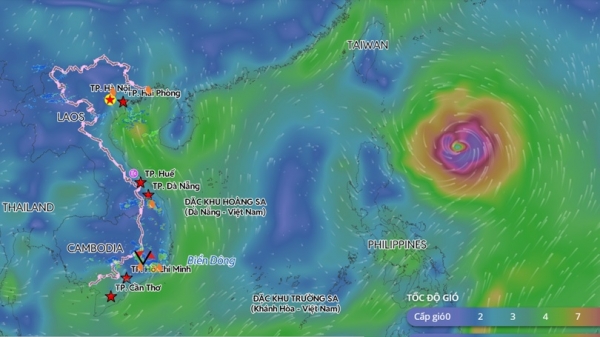
Typhoon Mekhala May Intensify into Super Typhoon: Weather Forecasting Technology Faces New Challenges
In recent hours, Typhoon Mekhala has continuously intensified, presenting significant challenges for weather forecasting technology and disaster prevention efforts. Forecasts indicate that within the next 12-24 hours, the typhoon may strengthen to level 16, becoming a super typhoon with winds exceeding level 17.
Current Status of Typhoon Mekhala
According to information from the National Center for Hydro-Meteorological Forecasting, Typhoon Mekhala is moving west-northwest at approximately 15-20km/h. Over the past 6 hours, the maximum wind speed near the typhoon's center has increased to levels 14-15 (134-150km/h), with gusts reaching level 17.
Modern weather monitoring systems, including next-generation meteorological satellites and automated observation networks, are closely tracking the typhoon's development. Advanced weather radar technology has also recorded strong rotating winds forming within the typhoon's center.
Weather Forecasting Technology Faces Challenges
The rapid intensification of Typhoon Mekhala poses significant challenges for weather forecasting models. Experts suggest this case exemplifies the increasing complexity of extreme weather phenomena in the context of climate change.
Supercomputers used for meteorological modeling are operating at maximum capacity to provide the most accurate forecasts. However, forecast accuracy still depends on input data quality and analytical algorithms.
Detailed Forecast and Potential Impacts
Based on updated forecast models, Typhoon Mekhala is expected to continue strengthening over the next 12-24 hours. By that time, maximum wind speeds could reach level 16 (184-201km/h), with gusts exceeding level 17.
Satellite monitoring systems have detected strong convective clouds developing within the typhoon's core, an indication that the storm is in a strong development phase.
| Typhoon Classification Scale in the Northwest Pacific Region | |
|---|---|
| Typhoon Level | Wind Speed (km/h) |
| Levels 8-9 | 62-88 |
| Levels 10-11 | 89-117 |
| Levels 12-13 | 118-149 |
| Levels 14-15 | 150-183 |
| Levels 16-17 (Super Typhoon) | 184-220 |
Impacts and Response Technologies
Modern weather forecasting technology has helped authorities gain more preparation time for responding to Super Typhoon Mekhala. Early warning systems have been activated, enabling the evacuation of residents from high-risk areas.
Drones equipped with sensors have been deployed to collect direct data from the typhoon's core, providing valuable information for forecasters. Artificial intelligence technology is also being used to analyze satellite imagery and more accurately predict the typhoon's path.
Historical Comparison with Other Typhoons
Compared to other typhoons in the region, Mekhala has a faster-than-average intensification rate. The following table compares it to some of the strongest typhoons in the past decade:
| Typhoon Name | Year | Maximum Level | Intensification Rate | Impact |
|---|---|---|---|---|
| Haiyan | 2013 | Level 5 | Fast | Philippines: >6,300 deaths |
| Mangkhut | 2018 | Level 5 | Average | Philippines, Hong Kong, China: >130 deaths |
| Molave | 2020 | Level 4 | Slow | Vietnam: Heavy agricultural damage |
| Mekhala | 2023 | Forecast Level 16 | Very Fast | Monitoring ongoing |
Expert Analysis
According to Dr. Nguyen Van Huong, a climate expert at the Institute of Meteorology and Hydrology: "The rapid intensification of Typhoon Mekhala is clear evidence of climate change impacts. While modern forecasting technology has improved significantly, we need to invest more in research and development to cope with increasingly extreme weather phenomena."
Experts emphasize that weather forecasting technology must be combined with early warning systems and effective disaster prevention measures to minimize loss of life and property damage.
Conclusion
Super Typhoon Mekhala presents a major challenge for weather forecasting technology and disaster prevention efforts. The rapid development of new technologies such as AI, big data, and next-generation weather satellites has significantly improved forecasting capabilities, but many challenges remain ahead.
Authorities recommend that residents in potentially affected areas proactively follow information from official sources and implement necessary preventive measures to ensure safety for life and property.