#Electricity Law #Electrical PlanningVIII #EVN #LNG #Offshore Wind Power #BESS #DPPA #Energy #EnergySecurity #EnergyTransfer #CongListDauKhi
If the Electricity Planning has outlined a series of projects but tens of billions of dollars have not yet been disbursed due to procedural and mechanism problems, is the biggest bottleneck in Vietnam's electricity industry today still the lack of electricity or the lack of institutions?
Vietnam's electricity industry is entering the most important phase in decades when electricity demand increases rapidly, pressure to reduce emissions is increasing and a series of LNG projects, offshore wind power, solar power, pumped storage hydropower and energy storage systems are included in the adjusted Power Plan VIII.
However, reality shows that the planning is in place but implementation progress is still slower than expected. Many large projects still face difficulties in selecting investors, mobilizing capital, negotiating power purchase contracts and accessing transmission infrastructure.
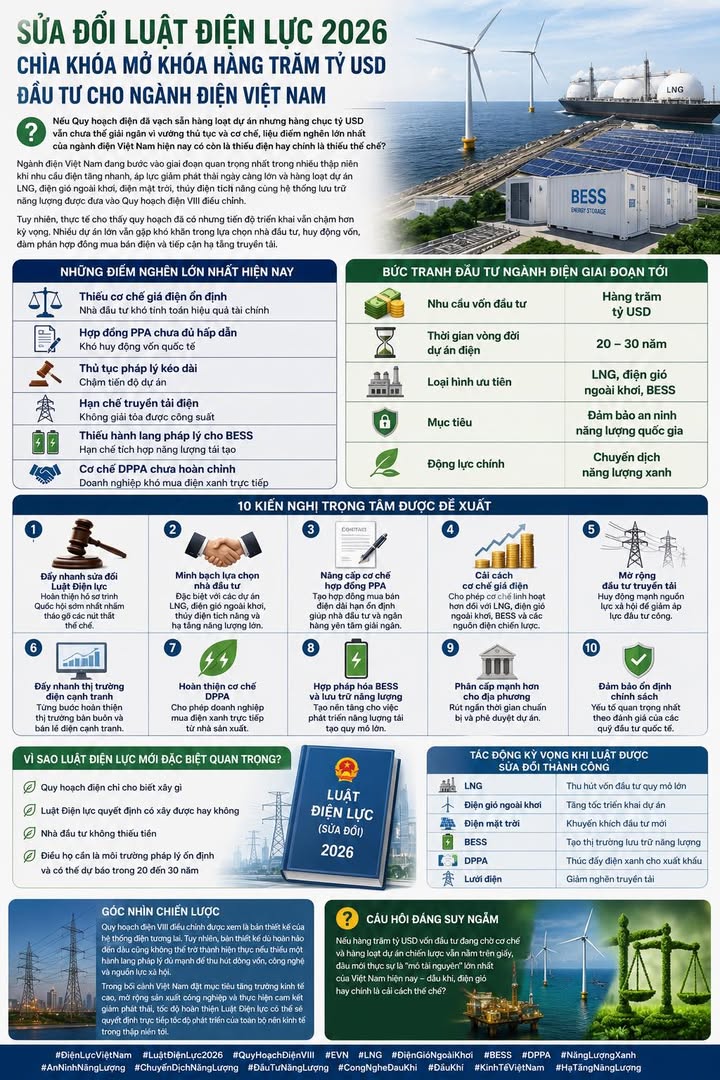
The biggest bottlenecks today
Impact Issue
Lack of a stable electricity price mechanism makes it difficult for investors to calculate financial efficiency
PPA contracts are not attractive enough. Difficult to mobilize international capital
Legal procedures are lengthyi Delay in project progress
Limiting power transmission Cannot release capacity
Lack of legal framework for BESS Limits the integration of renewable energy
The DPPA mechanism is not complete. It is difficult for businesses to buy green electricity directly
The picture of investment in the electricity industry in the coming period
Scale Criteria
Investment capital needs Hundreds of billions of USD
Power project life cycle time is 20 - 30 years
Priority types: LNG, offshore wind power, BESS
Objective: Ensuring national energy security
Main driving force Green energy transition
10 key recommendations are proposed
1. Accelerate amendments to the Electricity Law
Complete documents submitted to the National Assembly as soon as possible to remove institutional bottlenecks that are slowing down the progress of a series of power projects.
2. Transparency in investor selection
Especially with LNG projects, offshore wind power, pumped storage hydropower and large-scale energy infrastructure projects.
3. Upgrade the PPA contract mechanism
Creating stable long-term power purchase contracts helps banks and investors feel secure in disbursement.
4. Reform the electricity price mechanism
Allows for more flexible mechanisms for LNG, offshore wind, BESS and strategic power sources.
5. Expand transmission investment
Strongly mobilize social resources to reduce pressure on public investment.
6. Push nhUK competitive electricity market
Gradually perfect the competitive wholesale and retail electricity market.
7. Complete the DPPA mechanism
Allows businesses to buy green electricity directly from manufacturers.
8. Legalization of BESS and energy storage
Create a foundation for large-scale renewable energy development.
9. Stronger decentralization for localities
Shorten project preparation and approval time.
10. Ensure policy stability
This is the factor that international investment funds consider most important when deciding to invest capital.
Why is the new Electricity Law especially important?
Electrical planning only tells what to build
The Electricity Law decides whether it can be built or not
Investors do not lack money
What they need is a stable and predictable regulatory environment for 20 to 30 years
Expected impact when the Law is successfully amended
Area of Impact
LNG Attracts large-scale investment capital
Offshore wind power Accelerate project implementation
Solar power Encourages new investment
BESS Creating an energy storage market
DPPA Promote green electricity for export
Power grid Reduces transmission congestion
Strategic perspective
The adjusted Power Plan VIII is considered a blueprint of the future power system. However, no matter how perfect the design is,Europe cannot become a reality without a legal corridor strong enough to attract capital flows, technology and social resources.
In the context of Vietnam aiming for high economic growth, expanding industrial production and implementing emissions reduction commitments, the speed of completion of the Electricity Law will likely directly determine the growth rate of the entire economy in the next decade.
A question worth pondering for the energy community
If hundreds of billions of dollars in investment capital are waiting for a mechanism and a series of strategic projects are still on paper, what is truly Vietnam's largest "resource mine" today - oil and gas, wind power or institutional reform?
#Vietnam Electricity #Electrical Law2026 #Electrical PlanningVIII #EVN #LNG #Offshore Wind Power #BESS #DPPA #Green Energy #Energy Security #Energy Transition #Energy Investment #CongHeatDauKhi #OilGas #Vietnam's Economy #Energy Infrastructure