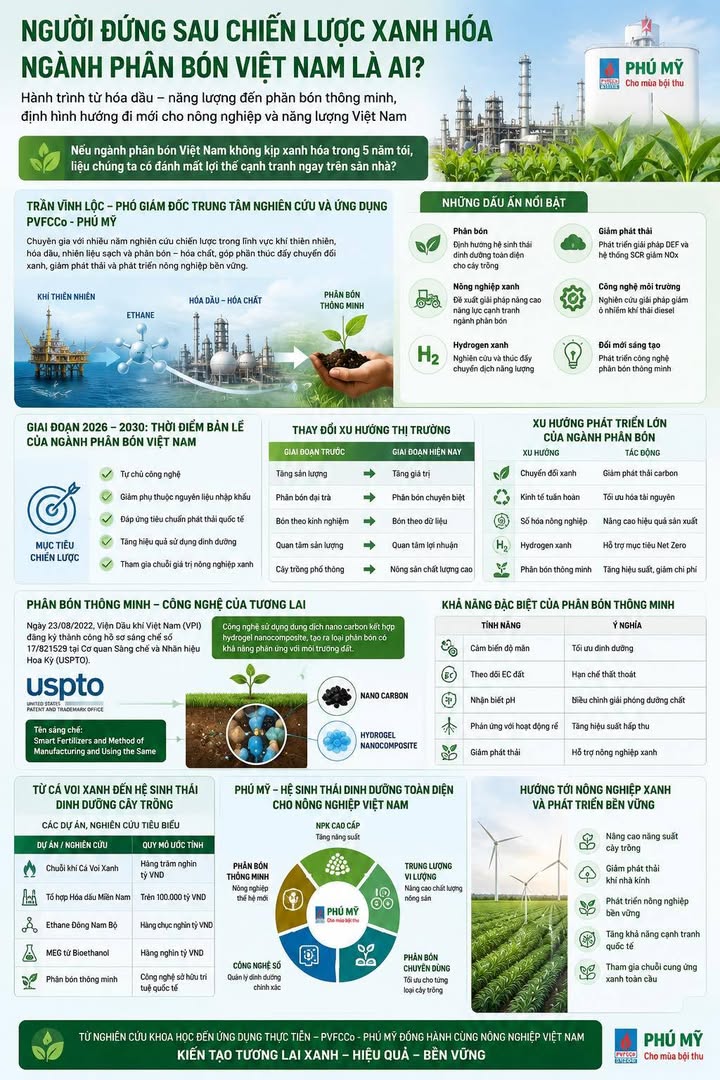
The Architects Behind Vietnam's Fertilizer Industry Green Transformation
In an era where global environmental standards are becoming increasingly stringent, Vietnam's fertilizer industry faces a critical question: can it successfully undergo green transformation within the next five years to maintain its competitive edge both domestically and internationally?
As Vietnam's agriculture enters a phase of profound transformation toward sustainability, reduced carbon emissions, and environmental responsibility, the role of research scientists has become pivotal in shaping the future of the fertilizer sector. Among the prominent figures in this field is Mr. Trần Vĩnh Lộc, Deputy Director of the Research and Application Center under the Petrovietnam Fertilizer and Chemical Corporation (PVFCCo) - Phu My.
Not only is Mr. Trần Vĩnh Lộc involved in research to enhance fertilizer use efficiency, but he has also emerged as a frequent participant in professional forums related to green hydrogen, greenhouse gas emission reduction, clean energy, diesel engine emission control, and the development of comprehensive nutritional ecosystems for crops.
Notable Contributions and Expertise Areas
Mr. Trần Vĩnh Lộc's work spans multiple domains, each contributing to the broader goal of sustainable agriculture and industrial transformation. His expertise encompasses:
| Field of Activity | Typical Contributions |
|---|---|
| Fertilizer Science | Guiding the development of comprehensive nutritional ecosystems for crops |
| Green Agriculture | Proposing solutions to enhance the competitive capacity of the fertilizer industry |
| Green Hydrogen | Participating in research and promoting energy transition initiatives |
| Emission Reduction | Developing DEF solutions and SCR systems to reduce NOx emissions |
| Environmental Technology | Researching solutions to reduce diesel exhaust pollution |
The Critical Period: 2026-2030
According to recent assessments, the period from 2026 to 2030 represents a fundamental turning point for Vietnam's fertilizer industry. During this time, the sector must simultaneously address multiple critical challenges:
- Technological self-reliance
- Reducing dependence on imported raw materials
- Meeting international emission standards
- Increasing nutrient use efficiency for crops
- Participating in green agricultural value chains
Major Trends in the Fertilizer Industry
The fertilizer industry is experiencing significant transformation globally. Understanding these trends is essential for Vietnam's sector to remain competitive:
| Trend | Impact |
|---|---|
| Green Transformation | Reduction of carbon emissions throughout the production process |
| Circular Economy | Optimization of resource utilization and waste reduction |
| Digital Agriculture | Enhanced production efficiency through data-driven decision making |
| Green Hydrogen | Supporting net zero emission goals in industrial processes |
| Smart Fertilizers | Reducing cultivation costs through precision application |
From Fertilizers to Green Energy
Notably, Mr. Trần Vĩnh Lộc's research scope extends beyond traditional fertilizer applications. In various energy and environmental industry seminars, he has frequently shared insights on the role of green hydrogen in the energy transition process, as well as solutions for reducing NOx emissions through DEF and SCR technologies.
This approach aligns with global trends where major chemical and fertilizer companies worldwide are transforming into integrated providers of energy and environmental solutions. The integration of fertilizer production with green energy technologies represents a strategic evolution that could redefine industry boundaries and create new competitive advantages.
Goals of Vietnam's Fertilizer Industry
As Vietnam moves toward its 2050 net zero emissions commitment, the fertilizer industry has established several key objectives:
- Improving crop yields
- Reducing greenhouse gas emissions
- Developing sustainable agricultural practices
- Enhancing international competitiveness
- Participating in global green supply chains
Future Outlook
With Vietnam's commitment to achieving net zero emissions by 2050, the role of research teams within industrial enterprises like PVFCCo has become increasingly important. Research in green fertilizers, green hydrogen, emission reduction, and circular economy will likely determine the competitive position of Vietnam's fertilizer industry for decades to come.
What is particularly thought-provoking is that while many people only see the final product in the market, behind it lies an entire ecosystem of technology research where experts like Mr. Trần Vĩnh Lộc are contributing to shape the future of Vietnam's agriculture and energy sectors.
Conclusion
The green transformation of Vietnam's fertilizer industry represents not just a technological shift but a fundamental reimagining of agricultural production in the context of climate change and environmental sustainability. The work of researchers and industry leaders like Mr. Trần Vĩnh Lộc will be instrumental in navigating this transition.
As Vietnam positions itself in the global agricultural landscape, the integration of traditional fertilizer expertise with emerging technologies in green energy and environmental protection will be key to creating a sustainable and competitive industry for future generations.