Petrovietnam: The Journey to Becoming a National Energy Pillar
What would happen if Petrovietnam were to suspend electricity generation for just a few days? Would Vietnam's power system be capable of compensating for the more than 10% of national electricity production currently supplied by this conglomerate?
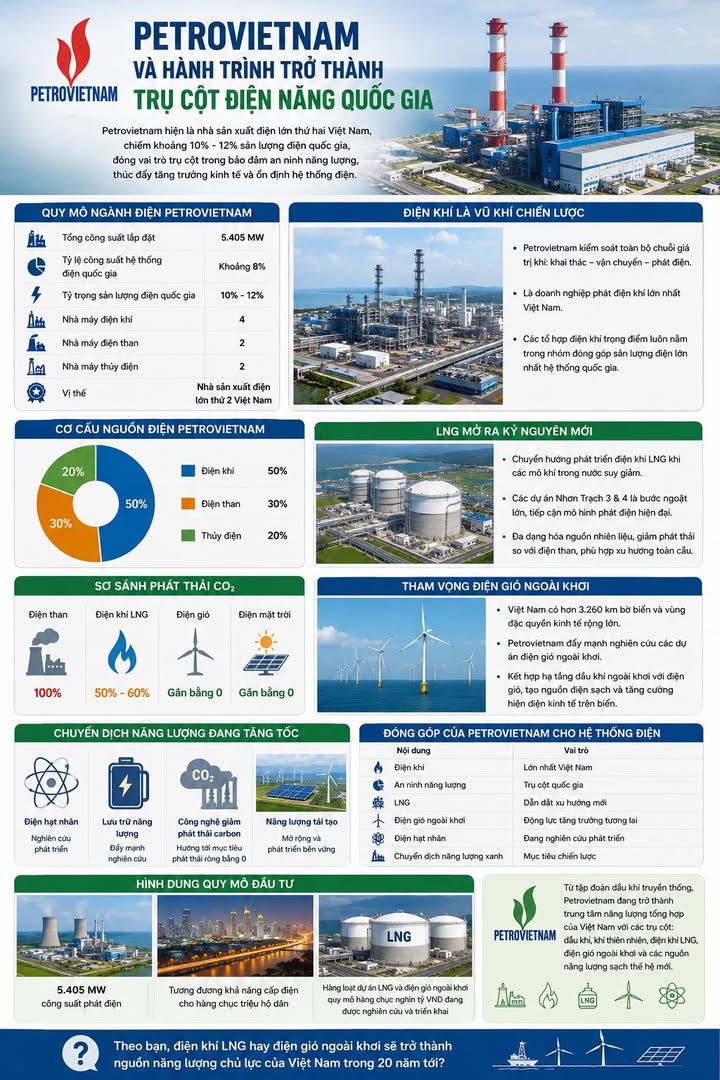
For many years, Petrovietnam has been known not only as Vietnam's largest oil and gas corporation but also as one of the country's most important electricity producers. With a total installed capacity of approximately 5,405 MW, Petrovietnam currently ranks as the second-largest electricity producer in Vietnam and the largest gas-based electricity generator nationwide.
The electricity supplied by Petrovietnam currently accounts for about 10% to 12% of Vietnam's total electricity generation, playing a particularly crucial role in ensuring energy security, supporting economic growth, and stabilizing the national power system.
The Scale of Petrovietnam's Electricity Sector
| Indicator | Value |
|---|---|
| Total installed capacity | 5,405 MW |
| Percentage of national power system capacity | Approximately 8% |
| Share of national electricity production | 10% - 12% |
| Gas power plants | 4 |
| Coal power plants | 2 |
| Hydropower plants | 2 |
| Market position | Second-largest electricity producer in Vietnam |
Gas Power: Petrovietnam's Strategic Weapon
Unlike many traditional power companies, Petrovietnam possesses a unique advantage by controlling the entire value chain from natural gas extraction, transportation, to power generation.
This integration has established Petrovietnam as Vietnam's largest gas-based electricity producer, creating a significant competitive advantage in terms of fuel sources and operational stability.
Petrovietnam's key gas power complexes have consistently ranked among the largest contributors to the national power system's output for many years.
Structure of Petrovietnam's Electricity Generation Portfolio
| Energy Source | Percentage of Portfolio |
|---|---|
| Gas Power | 50% |
| Coal Power | 30% |
| Hydropower | 20% |
LNG Opens a New Era
As domestic gas fields entered their natural decline phase, Petrovietnam quickly shifted its focus to developing LNG-based electricity generation.
Projects like Nhon Trach 3 and Nhon Trach 4 represent significant milestones, helping Vietnam access the modern power generation model adopted by many developed nations.
LNG not only diversifies fuel sources but also reduces emissions compared to traditional coal power, aligning with global energy transition trends.
CO2 Emission Comparison
| Energy Type | Relative CO2 Emission Level |
|---|---|
| Coal Power | 100% |
| LNG Gas Power | 50% - 60% |
| Offshore Wind Power | Nearly 0% |
| Solar Power | Nearly 0% |
Ambitions in Offshore Wind Power
Not stopping at gas power, Petrovietnam is actively researching offshore wind power projects.
This sector is considered to have enormous potential, as Vietnam possesses over 3,260 km of coastline and a vast exclusive economic zone.
Combining offshore oil and gas infrastructure with wind farms not only creates clean electricity but also enhances economic presence in maritime areas, supporting national sovereignty protection.
Accelerating Energy Transition
Alongside gas power and renewable energy, Petrovietnam is also participating in research of emerging fields such as nuclear power, energy storage, and carbon reduction technologies.
These strategic orientations indicate Petrovietnam's gradual transformation from a traditional oil and gas corporation into a modern integrated energy industry group.
Petrovietnam's Contributions to the Power System
| Area | Role |
|---|---|
| Gas Power | Largest in Vietnam |
| Energy Security | National pillar |
| LNG | Leading new trends |
| Offshore Wind Power | Future growth driver |
| Nuclear Power | Under research and development |
| Green Energy Transition | Strategic objective |
Scale of Investment
With 5,405 MW of power generation capacity, Petrovietnam's operations can provide electricity to tens of millions of households.
A series of LNG and offshore wind projects worth tens of trillions of VND are currently being researched and implemented.
Conclusion: A New Development Stage
Petrovietnam is entering a completely new phase of development. From its traditional role as an oil and gas extractor, the corporation is gradually becoming Vietnam's comprehensive energy center with key pillars including oil and gas, natural gas, LNG-based electricity, offshore wind power, and next-generation clean energy sources.
This transformation positions Petrovietnam not just as a national energy producer but as a strategic player in Vietnam's broader energy transition, balancing economic development with environmental sustainability and energy security.